Categories
Archives

Google has added Digital Source Type support to Google Merchant Center, enabling images created by generative AI engines to be flagged as such in Google’s products such as Google search, maps, YouTube and Google Shopping.
In a new support post, Google reminds merchants who wish their products to be listed in Google search results and other products that they should not strip embedded metadata, particularly the Digital Source Type field which can be used to signal that content was created by generative AI.
We at the IPTC fully endorse this position. We have been saying for years that website publishers should not strip metadata from images. This should also include tools for maintaining online product inventories, such as Magento and WooCommerce. We welcome contact from developers who wish to learn more about how they can preserve metadata in their images.
Here’s the full text of Google’s recommendation:
![Preserving metadata tags for AI-generated images in Merchant Center
February 2024
If you’re using AI-generated images in Merchant Center, Google requires that you preserve any metadata tags which indicate that the image was created using generative AI in the original image file.
Don't remove embedded metadata tags such as trainedAlgorithmicMedia from such images. All AI-generated images must contain the IPTC DigitalSourceType trainedAlgorithmicMedia tag. Learn more about IPTC photo metadata.
These requirements apply to the following image attributes in Merchant Center Classic and Merchant Center Next:
Image link [image_link]
Additional image link [additional_image_link]
Lifestyle image link [lifestyle_image_link]
Learn more about product data specifications.](https://iptc.org/wp-content/uploads/2024/02/Screenshot-2024-02-20-at-09.56.52-1024x724.png)
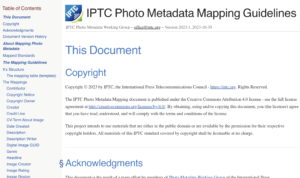 The IPTC is happy to announce the latest version of our guidance for mapping between photo metadata standards.
Following our publication of IPTC’s rules for mapping photo metadata between IPTC, Exif and schema.org standards in 2022, the IPTC Photo Metadata Working Group has been monitoring updates in the photo metadata world.
In particular, the IPTC gave support and advice to CIPA while it was working on Exif 3.0 and we have updated our mapping rules to work with the latest changes to Exif expressed in Exif 3.0.
As well as guidelines for individual properties between IPTC Photo Metadata Standard (in both the older IIM form and the newer XMP embedding format), Exif and schema.org, we have included some notes on particular considerations for mapping contributor, copyright notice, dates and IDs.
The IPTC encourages all developers who previously consulted the out-of-date Metadata Working Group guidelines (which haven’t been updated since 2008 and are no longer published) to use this guide instead.

Updated in June 2024 to include an image containing the new metadata property
Many image rights owners noticed that their assets were being used as training data for generative AI image creators, and asked the IPTC for a way to express that such use is prohibited. The new version 2023.1 of the IPTC Photo Metadata Standard now provides means to do this: a field named “Data Mining” and a standardised list of values, adopted from the PLUS Coalition. These values can show that data mining is prohibited or allowed either in general, for AI or Machine Learning purposes or for generative AI/ML purposes. The standard was approved by IPTC members on 4th October 2023 and the specifications are now publicly available.
Because these data fields, like all IPTC Photo Metadata, are embedded in the file itself, the information will be retained even after an image is moved from one place to another, for example by syndicating an image or moving an image through a Digital Asset Management system or Content Management System used to publish a website. (Of course, this requires that the embedded metadata is not stripped out by such tools.)
Created in a close collaboration with PLUS Coalition, the publication of the new properties comes after the conclusion of a public draft review period earlier this year. The properties are defined as part of the PLUS schema and incorporated into the IPTC Photo Metadata Standard in the same way that other properties such as Copyright Owner have been specified.
The new properties are now finalised and published. Specifically, the new properties are as follows:
- Data Mining: a field with a value from a controlled value vocabulary. Values come from the PLUS Data Mining vocabulary, reproduced here:
- http://ns.useplus.org/ldf/vocab/DMI-UNSPECIFIED (Unspecified – no prohibition defined)
- http://ns.useplus.org/ldf/vocab/DMI-ALLOWED (Allowed)
- http://ns.useplus.org/ldf/vocab/DMI-PROHIBITED-AIMLTRAINING (Prohibited for AI/ML training)
- http://ns.useplus.org/ldf/vocab/DMI-PROHIBITED-GENAIMLTRAINING (Prohibited for Generative AI/ML training)
- http://ns.useplus.org/ldf/vocab/DMI-PROHIBITED-EXCEPTSEARCHENGINEINDEXING (Prohibited except for search engine indexing)
- http://ns.useplus.org/ldf/vocab/DMI-PROHIBITED (Prohibited)
- http://ns.useplus.org/ldf/vocab/DMI-PROHIBITED-SEECONSTRAINT (Prohibited, see Other Constraints property)
- http://ns.useplus.org/ldf/vocab/DMI-PROHIBITED-SEEEMBEDDEDRIGHTSEXPR (Prohibited, see Embedded Encoded Rights Expression property)
- http://ns.useplus.org/ldf/vocab/DMI-PROHIBITED-SEELINKEDRIGHTSEXPR (Prohibited, see Linked Encoded Rights Expression property)
- Other Constraints: Also defined in the PLUS specification, this text property is to be used when the Data Mining property has the value “http://ns.useplus.org/ldf/vocab/DMI-PROHIBITED-SEECONSTRAINT“. It can specify, in a human-readable form, what other constraints may need to be followed to allow Data Mining, such as “Generative AI training is only allowed for academic purposes” etc.
The IPTC and PLUS Consortium wish to draw users attention to the following notice included in the specification:
Regional laws applying to an asset may prohibit, constrain, or allow data mining for certain purposes (such as search indexing or research), and may overrule the value selected for this property. Similarly, the absence of a prohibition does not indicate that the asset owner grants permission for data mining or any other use of an asset.
The prohibition “Prohibited except for search engine indexing” only permits data mining by search engines available to the public to identify the URL for an asset and its associated data (for the purpose of assisting the public in navigating to the URL for the asset), and prohibits all other uses, such as AI/ML training.
The IPTC encourages all photo metadata software vendors to incorporate the new properties into their tools as soon as possible, to support the needs of the photo industry.
ExifTool, the command-line tool for accessing and manipulating metadata in image files, already supports the new properties. Support was added in the ExifTool version 12.67 release, which is available for download on exiftool.org.
The new version of the specification can be accessed at https://www.iptc.org/std/photometadata/specification/IPTC-PhotoMetadata or from the navigation menu on iptc.org. The IPTC Get Photo Metadata tool and IPTC Photo Metadata Reference images been updated to use the new properties.
The IPTC and PLUS Coalition wish to thank many IPTC and PLUS member organisations and others who took part in the consultation process around these changes. For further information, please contact IPTC using the Contact Us form.

We at IPTC receive many requests for help and advice regarding editing embedded photo and video metadata, and this has only increased with the recent news about the IPTC Digital Source Type property being used to identify content created by a generative AI engine.
In response, we have created some guidance: Developers’ and power users’ guide to reading and writing IPTC Photo Metadata
This takes the form of a wiki, so that it can be easily maintained and extended with more information and examples.
In its initial form, the documentation focuses on:
- Using the ExifTool command-line tool to read and write IPTC Photo Metadata,. ExifTool is commonly used by developers and power users to explore embedded metadata;
- Reading and writing image metadata in Python using the pyexiftool module;
- Reading and writing metadata in JavaScript (or TypeScript) using the node-exiftool module.
In each guide, we advise on how to read and create DigitalSourceType metadata for generative AI images, and also how to read and write the Creator, Credit Line, Web Statement of Rights and Licensor information that is currently used by Google image search to expose copyright information alongside search results.
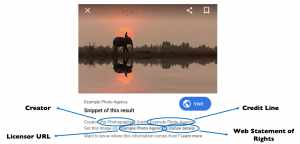
We hope that these guides will help to demystify image metadata and encourage more developers to include more metadata in their image editing and publishing workflows.
We will add more guidance over the coming months in more programming languages, libraries and frameworks. Of particular interest are guides to reading and writing IPTC Photo Metadata in PHP, C and Rust.
Contributions and feedback are welcome. Please contact us if you are interested in contributing.
The IPTC is proud to announce that after intense work by most of its Working Groups, we have published version 1.0 of our guidelines document: Expressing Trust and Credibility Information in IPTC Standards.
The culmination of a large amount of work over the past several years across many of IPTC’s Working Groups, the document represents a guide for news providers as to how to express signals of trust known as “Trust Indicators” into their content.
Trust Indicators are ways that news organisations can signal to their readers and viewers that they should be considered as trustworthy publishers of news content. For example, one Trust Indicator is a news outlet’s corrections policy. If the news outlet provides (and follows) a clear guideline regarding when and how it updates its news content.
The IPTC guideline does not define these trust indicators: they were taken from existing work by other groups, mainly the Journalism Trust Initiative (an initiative from Reporters Sans Frontières / Reporters Without Borders) and The Trust Project (a non-profit founded by Sally Lehrman of UC Santa Cruz).
The first part of the guideline document shows how trust indicators created by these standards can be embedded into IPTC-formatted news content, using IPTC’s NewsML-G2 and ninjs standards which are both widely used for storing and distributing news content.
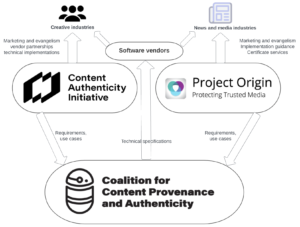
The second part of the IPTC guidelines document describes how cryptographically verifiable metadata can be added to media content. This metadata may express trust indicators but also more traditional metadata such as copyright, licensing, description and accessibility information. This can be achieved using the C2PA specification, which implements the requirements of the news industry via Project Origin and of the wider creative industry via the Content Authenticity Initiative. The IPTC guidelines show how both IPTC Photo Metadata and IPTC Video Metadata Hub metadata can be included in a cryptographically signed “assertion”
We expect these guidelines to evolve as trust and credibility standards and specifications change, particularly in light of recent developments in signalling content created by generative AI engines. We welcome feedback and will be happy to make changes and clarifications based on recommendations.
The IPTC sends its thanks to all IPTC Working Groups that were involved in creating the guidelines, and to all organisations who created the trust indicators and the frameworks upon which this work is based.
Feedback can be shared using the IPTC Contact Us form.
The IPTC NewsCodes Working Group has approved an addition to the Digital Source Type NewsCodes vocabulary.

The new term, “Composite with Trained Algorithmic Media“, is intended to handle situations where the “synthetic composite” term is not specific enough, for example a composite that is specifically made using an AI engine’s “inpainting” or “outpainting” operations.
The full Digital Source Type vocabulary can be accessed from https://cv.iptc.org/newscodes/digitalsourcetype. It can be downloaded in NewsML-G2 (XML), SKOS (RDF/XML, Turtle or JSON-LD) to be integrated into content management and digital asset management systems.
The new term can be used immediately with any tool or standard that supports IPTC’s Digital Source Type vocabulary, including the C2PA specification, the IPTC Photo Metadata Standard and IPTC Video Metadata Hub.
Information on the new term will soon be added to IPTC’s Guidance on using Digital Source Type in the IPTC Photo Metadata User Guide.

CIPA, the Camera and Imaging Products Association based in Japan, has released version 3.0 of the Exif standard for camera data.
The new specification, “CIPA DC-008-Translation-2023 Exchangeable image file format for digital still cameras: Exif Version 3.0” can be downloaded from https://www.cipa.jp/std/documents/download_e.html?DC-008-Translation-2023-E.
Version 1.0 of Exif was released in 1995. The previous revision, 2.32, was released in 2019. The new version introduces some major changes so the creators felt it was necessary to increment the major version number.
Fully internationalised text tags
In previous versions, text-based fields such as Copyright and Artist were required to be in ASCII format, meaning that it was impossible to express many non-English words in Exif tags. (In practice, many software packages simply ignored this advice and used other character sets anyway, violating the specification.)
In Exif 3.0, a new datatype “UTF-8” is introduced, meaning that the same field can now support internationalised character sets, from Chinese to Arabic and Persian.
Unique IDs
The definition of the ImageUniqueID tag has been updated to more clearly specify what type of ID can be used, when it should be updated (never!), and to suggest an algorithm:
This tag indicates an identifier assigned uniquely to each image. It shall be recorded as an ASCII string in hexadecimal notation equivalent to 128-bit fixed length UUID compliant with ISO/IEC 9834-8. The UUID shall be UUID Version 1 or Version 4, and UUID Version 4 is recommended. This ID shall be assigned at the time of shooting image, and the recorded ID shall not be updated or erased by any subsequent editing.
Guidance on when and how tag values can be modified or removed
Exif 3.0 adds a new appendix, Annex H, “Guidelines for Handling Tag Information in Post-processing by Application Software”, which groups metadata into categories such as “structure-related metadata” and “shooting condition-related metadata”. It also classifies metadata in groups based on when they should be modified or deleted, if ever.
|
Category |
Description |
Examples (list may not be exhaustive) |
|
Update 0 |
Shall be updated with image structure change |
DateTime (should be updated with every edit), ImageWidth, Compression, BitsPerSample |
|
Update 1 |
Can be updated regardless of image structure change |
ImageDescription, Software, Artist, Copyright, UserComment, ImageTitle, ImageEditor, ImageEditingSoftware, MetadataEditingSoftware |
|
Freeze 0 |
Shall not be deleted/updated at any time |
ImageUniqueID |
|
Freeze 1 |
Can be deleted in special cases |
Make, Model, BodySerialNumber |
|
Freeze 2 |
Can be corrected [if wrong], added [if empty] or deleted [in special cases] |
DateTimeOriginal, DateTimeDigitized, GPSLatitude, GPSLongitude, LensSpecification, Humidity |
Collaboration between CIPA and IPTC
CIPA and IPTC representatives meet regularly to discuss issues that are relevant to both organisations. During these meetings IPTC has contributed suggestions to the Exif project, particularly around internationalised fields and unique IDs.
We are very happy for our friends at CIPA for reaching this milestone, and hope to continue collaborating in the future.
Developers of photo management software understand that values of Exif tags and IPTC Photo Metadata properties with a similar purpose should be synchronised, but sometimes it wasn’t clear exactly which properties should be aligned. IPTC and CIPA collaborated to create a Mapping Guideline to help software developers implement it properly. Most professional photo software now supports these mappings.
Complete list of changes in Exif 3.0
The full set of changes in Exif 3.0 are as follows (taken from the history section of the PDF document):
- Added Tag Type of UTF-8 as Exif specific tag type.
- Enabled to select UTF-8 character string in existing ASCII-type tags
- Enabled APP11 Marker Segment to store a Box-structured data compliant with the JPEG System standard
- Added definition of Box-structured Annotation Data
- Added and changed the following tags:
- Added Title Tag
- Added Photographer Information related Tags (Photographer and ImageEditor)
- Added Software Information related Tags (CameraFirmware, RAWDevelopingSoftware, ImageEditingSoftware, and MetadataEditingSoftware)
- Changed Software, Artist, and ImageUniqueID
- Corrected incorrect definition of GPSAltitudeRef
- GPSMeasureMode tag became to support positioning information obtained from GNSS in addition to GPS
- Changed the description support levels of the following tags:
- XResolution
- YResolution
- ResolutionUnit
- FlashpixVersion
- Discarded Annex E.3 to specify Application Software Guidelines
- Added Annex H. (at the time of publication) to specify Guidelines for Handling Tag Information in Post-processing by Application Software
- Added Annex I.and J. (both at the time of publication) for supplemental information of Annotation Data
- Added Annex K. (at the time of publication) to specify Original Preservation Image
- Corrected errors, typos and omissions accumulated up to this edition
- Restructured and revised the entire document structure and style
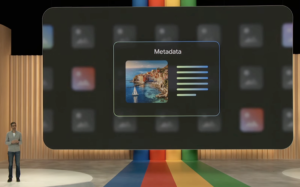
At today’s Google I/O event keynote, Sundar Pichai, CEO of Google, explained how Google will be using embedded IPTC image metadata to signal visual media created by generative AI models.
“Moving forward, we are building our models to include watermarking and other techniques from the start,” Pichai said. “If you look at a synthetic image, it’s impressive how real it looks, so you can imagine how important this is going to be in the future.
“Metadata allows content creators to associate additional context with original files, giving you more information whenever you encounter an image. We’ll ensure every one of our AI-generated images has that metadata.”
The IPTC Photo Metadata section of Google Images’ guidance on metadata has been updated with new guidance on the DigitalSourceType field:
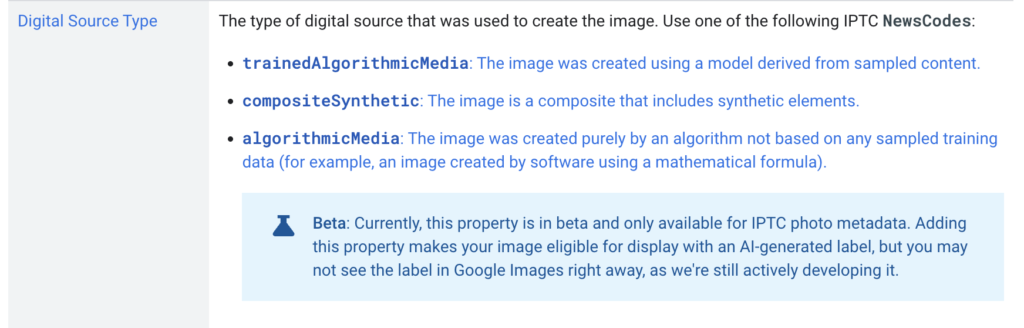
This follows the guidance on IPTC Photo Metadata for Generative AI that was recently published by IPTC.
“AI-Generated” label on Google Images
The above guidance hints at an “AI-generated label” to be used on Google Images in the future. Google recommends that all creators of AI-generated images use the IPTC Digital Source Type property to signal AI-generated content. While Google says that “you may not see the label in Google Images right away”, it appears that it will soon be available in Google Images search results.

The IPTC has updated its Photo Metadata User Guide to include some best practice guidelines for how to use embedded metadata to signal “synthetic media” content that was created by generative AI systems.
After our work in 2022 and the draft vocabulary to support synthetic media, the IPTC NewsCodes Working Group, Video Metadata Working Group and Photo Metadata Working Group worked together with several experts and organisations to come up with a definitive list of “digital source types” that includes various types of machine-generated content, or hybrid human and machine-generated media.
Since publishing the vocabulary, the work has been picked up by the Coalition for Content Provenance and Authenticity (C2PA) via the use of digitalSourceType in Actions and in the IPTC Photo and Video Metadata assertion. But the primary use case is for adding metadata to image and video files
Here is a direct link to the new section on Guidance for using Digital Source Type, including examples for how the various terms can be used to describe media created in different formats – audio, video, images and even text.
IPTC recommends that software creating images using trained AI algorithms uses the “Digital Source Type” value of “trainedAlgorithmicMedia” is added to the XMP data packet in generated image and video files. Alternatively, it may be included in a C2PA manifest as described in the IPTC assertion documentation in the C2PA specification.
The official URL for the full vocabulary is http://cv.iptc.org/newscodes/digitalsourcetype, so the complete URI for the recommended Trained Algorithmic Media term is http://cv.iptc.org/newscodes/digitalsourcetype/trainedAlgorithmicMedia.
Other terms in the vocabulary include:
- Composite with synthetic elements – https://cv.iptc.org/newscodes/digitalsourcetype/compositeSynthetic – covering a composite image that contains some synthetic and some elements captured with a camera;
- Digital Art – https://cv.iptc.org/newscodes/digitalsourcetype/digitalArt – covering art created by a human using digital tools such as a mouse or digital pencil, or computer-generated imagery (CGI) video
- Virtual recording – https://cv.iptc.org/newscodes/digitalsourcetype/virtualRecording – a recording of a virtual event which may or may not contain synthetic elements, such as a Fortnite game or a Zoom meeting
- and several other options – see the full list with examples in the IPTC Photo Metadata User Guide.
Of course, the original digital source type values covering photographs taken on a digital camera or phone (digitalCapture), scan from negative (negativeFilm), and images digitised from print (print) are also valid and may continue to be used. We have, however, retired the generic term “softwareImage” which is now deemed to be too generic. We recommend using one of the newer terms in its place.
If you are considering implementing this guidance in AI image generation software, we would love to hear about it so we can offer advice and tell others. Please contact us using the IPTC contact form.
Our friends at CEPIC are running a webinar in conjunction with Google on the Licensable badge in search results. The webinar is TODAY, February 21st, so there are still a few hours left to join.

Register for free at https://www.eventbrite.com/e/google-webinar-image-seo-and-licensable-badge-tickets-532031278877
Google webinar: Image SEO and Licensable Badge
In this webinar, John Mueller, Google’s Search Advocate, will cover Image SEO Best Practices and Google’s Licensable Badge. For the Licensable Badge, John will give an overview of the product and implementation guidelines. There will also be time for a Q&A session.
One of the methods for enabling your licensing metadata to be surfaced in Google Search results is to embed the correct IPTC Photo Metadata directly into image files. The other is to use schema.org markup in the page hosting the image. We explain more in the Quick Guide to IPTC Photo Metadata on Google Images, but you can also learn about it by attending this webinar.
Tuesday 21st February 2023, at 4 PM – 5PM Central European Time
Topics covered include:
• Image SEO best practices
• Licensable badge in Google image search results
• Q&A
This is a free webinar open to all those interested, not just CEPIC or IPTC members.