Categories
Archives

The IPTC Photo Metadata Working Group has released version 2025.1 of the IPTC Photo Metadata Standard, including properties that can be used for AI-generated content.
The new properties are:
- AI System Used
Definition: The AI engine and/or the model name used to generate this image.
User Note: For example, ChatGPT DALL-E, Google Gemini, ChatGPT
Suggest help text: Enter the name of the AI system and/or the model name used to generate this image. - AI System Version Used
Definition: The version of the AI system used to generate this image, if known.
Suggested help text: Enter the name or number of the version of the AI system used to generate this image. - AI Prompt Information
Definition: The information that was given to the generative AI service as “prompt(s)” in order to generate this image.
User Note: This may include negative [excludes] and positive [includes] statements in the prompt.
Suggested help text: Enter the information given to the generative AI service as “prompt(s)” in order to generate this image. - AI Prompt Writer Name
Definition: Name of the person who wrote the prompt used for generating this image.
User Note: This person should not be considered as the image creator.
Suggested help text: Enter the name of the person who wrote the prompt used for generating this image.
IPTC’s specification materials have been updated to accommodate the new properties:
- IPTC Photo Metadata Standard Specification 2025.1
- The IPTC Photo Metadata User Guide has been updated, particularly the guidance on Applying Metadata to AI-generated images
- The IPTC Photo Metadata Reference Image 2025.1 which contains values for all IPTC Photo Metadata properties, including the four properties added in version 2025.1
- IPTC Photo Metadata TechReference:
- The GetPMD photo metadata reading tool has been updated to read the new fields.
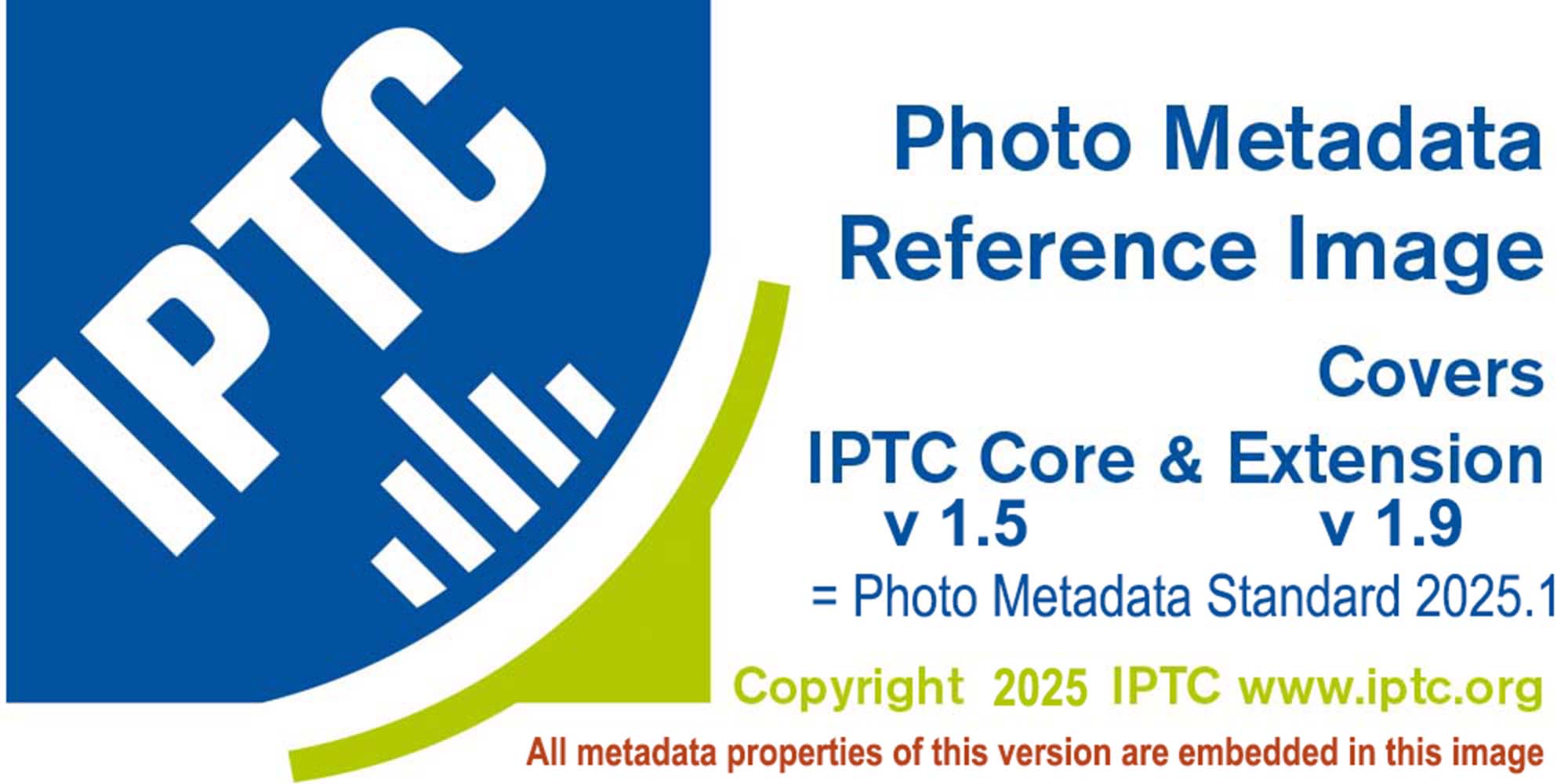
The new properties are expected to be implemented in software tools soon. The popular open-source tool Exiftool already supports the new properties, since version 13.40 which was released on October 24th 2025.
Thanks to everyone who contributed to our request for comments on these new properties. We made several changes based on feedback from IPTC members and others, so your contributions were well appreciated.
For more information please contact IPTC or join our public iptc-photometadata@groups.io mailing list.
Software industry legend Tim Bray gave a resounding call to IPTC and to others working on media provenance and C2PA: his verdict was that while the specification and its implementation had issues, they were slowly being resolved and he lauded the project’s goal of, in Tim’s words, “making it harder for liars to lie and easier for truth tellers to be believed”.
The 2025 Photo Metadata Conference, held on September 18th, was a great success, with 280 registered attendees from hundreds of organisations around the world. Video recordings from the event are now available.
Speakers included:
- David Riecks, lead of the IPTC Photo Metadata Working Group, describing some new IPTC Photo Metadata properties concerning Generative AI models and prompts that will be proposed for a vote at the next Standards Committee meeting to be held at the IPTC Autumn Meeting.
- Brendan Quinn, Managing Director of IPTC, gave an update on the IPTC’s guidelines for opting out of Generative AI training and ongoing work to standardise AI training preferences at the Internet Engineering Task Force (IETF)
- Ottar A. B. Anderson, Head of Photography at SEDAK, the GLAM imaging service of Møre og Romsdal County in Norway, spoke about Metadata for Image Quality in Galleries, Libraries, Archives and Museums (GLAM) and his work on the Digital Object Authenticity Working Group.
- David Riecks gave an update on IPTC Photo Metadata Panel in Adobe Custom Metadata.
- AI caption tagging for the Superbowl – Jerry Lai, Senior Director of Content, Imagn Images – Download Jerry’s slides
- Paul Reinitz, previously with Getty Images and now a consultant on business and legal issues around copyright, spoke about recent developments in the area including updates in the US, EU and China
- Brendan Quinn spoke again to give an update on the IPTC’s work with C2PA and the world of Media Provenance, including our work on the Verified News Publishers List
- Tim Bray, creator of tech standards like XML and Atom and companies like OpenText
- Marcos Armstrong of CBC / Radio Canada spoke about his work on mapping image publishing workflows at CBC.
Feedback from the event was almost universally positive:
- “While I knew I wouldn’t understand all of the terms, I was so impressed the amount of topics that were touched upon. I had no problem following along. I loved the passion and the openess to different perspectives”
- “Great topic choices- perfect level of beginner/more advanced content presentation.”
- “It was a good critical look at the pluses and minuses of various decisions being made, ultimately pointing to developing public trust about authorship.”
- “Informative, I really liked the expertise all the speaker brought to the virtual table”
- “Learning about strategies to protect from and tools for blocking AI, as well as metadata fields to record AI use”
- “Informative, good presentations and presenters. Very relevant to today – AI.”
- “Focus on Content Credentials and AI. Range of speaker roles provided different perspectives on the topic area. Excellent organization, presentation quality and management of the zoom space.”
- “Three things in particular stood out. Tim Bray’s talk was great as it brought everything to my world as a photographer and is pretty much what I’ve found. Brendan Quinn’s opt out information was definitely worth knowing and now I’m going to look at it. Finally, David Riecks talk about Adobe’s Metadata Panel gave me more insight into it and if it should be included in my workflow but his information for the proposed new properties for Generative AI was very good to hear.”
Thanks to everyone who attended and to our speakers David, Brendan, Paul, Ottar, Tim and Marcos.
Special thanks to David and the IPTC Photo Metadata Working Group for organising the event.
We look forward to seeing even more attendees next year!
To be sure of being notified about next year’s event, subscribe to the (very low volume) “Friends of IPTC Newsletter”.

The IPTC Photo Metadata Working Group is proposing a draft set of properties for recording details of images created using generative AI systems. The group presents a draft of these fields for your comments and feedback. After comments are reviewed the group intends to add new properties to a new version of the IPTC Photo Metadata Standard which would be released later in 2025.
Use Cases
The proposals detailed here are intended to address these scenarios, among others:
- How do you know which system/model generated this image? For instance, if you wanted to compare how different systems—or versions of systems—interpret a given prompt, where would you look?
- How can you know what prompt text was entered, or image shared as a starting point? If you want to recreate similar images in the future with the same look, where should that info be stored?
- How can you tell who was involved in the creation of a generative AI image?
Example Scenario
You are the new designer for an organisation, and need to create an image for a monthly column. You are told to use generative AI, but your boss wants the end result to have the same “look and feel” as images used previously in the column. If you needed to find those that were published previously—what information would be most useful in locating and retrieving the image(s) in your organization’s image collection?
Proposed Properties:
- AI Model
Name: AI Model
Definition: The foundational model name and version used to generate this image.
User Note: For example “DALL-E 2”, “Google Genesis 1.5 Pro”
Basic Specs: Data type: Text / Cardinality: 0..1 - AI Text Prompt Description
Name: AI Text Prompt Description
Definition: The information that was given to the generative AI service as “prompt(s)” in order to generate this image.
User Note: This may include negative [excludes] and positive [includes] statements in the prompt.
Basic Specs: Data type: Text / Cardinality: 0..1 - AI Prompt Writer Name
Name: AI Prompt Writer Name
Definition: Name of the person who wrote the prompt used for generating this image.
Basic Specs: Data type: Text / Cardinality: 0..1 - Reference Image(s)
Name: Reference Image
Definition: Image(s) used as a starting point to be refined by the generative AI system (sometimes referred to as “base image”).
Basic Specs: Data type: URI / Cardinality: 0..unbounded
All of these properties are of course optional, not required, but we would recommend that AI engines fill in the properties whenever possible.
Request for Comment
The intent is for a new standard version including these fields to be proposed at the IPTC Autumn Meeting 2025 in October to be voted on by IPTC member organisations. If approved by members, the new version would be published in November 2025.
Please send your comments or suggestions for improvements using the IPTC Contact Us form or via a post to the public iptc-photometadata@groups.io discussion list by Friday 29th August 2025.

Together with partner organisation the PLUS Coalition, the IPTC has submitted a response to the UK Intellectual Property Office’s consultation on Copyright and Artificial Intelligence.
Our position can be summarised as the following:
- On behalf of our memberships, IPTC and PLUS respectfully suggest that existing UK copyright law is sufficient to enable licensing of content to AI platforms. There is no “fair use” provision in UK copyright law, and “fair dealing” does not cover commercial AI training. Existing copyright law should be enforced.
- IPTC and PLUS Photo Metadata provide a technical means for expressing the creator’s intent as to whether their creations may be used in generative AI training data sets. This takes the form of metadata embedded in image and video files. This solution, in combination with other solutions such as the Text and Data Mining Reservation Protocol, could take the place of a formal licence agreement between parties, making an opt-in approach technically feasible and scalable.
- It is true that our technical solutions would also be relevant if the UK government chooses to implement an “opt-out” approach similar to that adopted in the EU. However, an opt-out-based approach does not currently protect owners’ rights well, due to the routine activity of “metadata stripping” – removing important rights and accessibility metadata that is embedded in media files, in the misguided belief that it will improve site performance. Metadata stripping is performed by many publishers and publishing systems – often inadvertently. (See our research on metadata stripping by social media platforms from 2019; very little has changed since then)
- As a result, we can only recommend that the UK adopts an opt-in approach. We request that the UK ensures metadata embedded in media files be declared as a core part of any technical mechanism to declare content owner’s desire for content to be included or excluded from training data sets.
During the course of this consultation, it has become clear that content creators are a core part of the UK economy and have a strong voice. We agree with their position, but we don’t simply come with another voice of complaint: we bring a viable, ready-made technical solution that can be used today to implement true opt-in data mining permissions and reservations.
The full document in PDF form can be viewed here:
At the IPTC Autumn Meeting, the IPTC Standards Committee voted on a change proposed by the Photo Metadata Working Group, which created version 2024.1 of the IPTC Photo Metadata Standard.
The change is minor but important to some: the definition of the Keywords property now includes the following text:
Keywords to express the subject and other aspects of the content of the image. Keywords may be free text and don’t have to be taken from a controlled vocabulary. Codes from the controlled vocabulary IPTC Subject NewsCodes must go to the “Subject Code” field.
This aligns the property definition with the way in which many photo agencies and photographers were already using the field: to convey aspects such as the lighting or lens effects used, “mood” of the image, dominant colour and more.
We give examples of how the Keywords property may be used in the IPTC Photo Metadata User Guide.
The relevant files have all been updated for the new version:
- The IPTC Photo Metadata Standard Specification
- The IPTC Photo Metadata User Guide
- The IPTC Photo Metadata TechReference, in both YAML and JSON formats
- The IPTC Photo Metadata Reference Image
We thank Agence France-Presse for their help in offering examples for how the Keywords property may be used.
 The IPTC has responded to a multi-stakeholder consultation on the recently-agreed European Union Artificial Intelligence Act (EU AI Act).
Although the IPTC is officially based in the UK, many of our members and staff operate from the European Union, and of course all of our members’ content is available in the EU, so it is very important to us that the EU regulates Artificial Intelligence providers in a way that is fair to all parts of the ecosystem, including content rightsholders, AI providers, AI application developers and end users.
In particular, we drew the EU AI Office’s attention to the IPTC Photo Metadata Data Mining property, which enables rightsholders to inform web crawlers and AI training systems of the rightsholders’ agreement as to whether or not the content can be used as part of a training data set for building AI models.
The points made are the same as the ones that we made to the IETF/IAB Workshop consultation: that embedded data mining declarations should be part of the ecosystem of opt-outs, because robots.txt, W3C TDM, C2PA and other solutions are not sufficient for all use cases.
The full consultation text and all public responses will be published by the EU in due course via the consultation home page.

The IPTC has signed a liaison agreement with the Japanese camera-makers organisation and creators of the Exif metadata standard, CIPA.
CIPA members include all of the major camera manufacturers, including Nikon, Canon, Sony, Panasonic, FUJIFILM and more. Several software vendors who work with imaging are also members, including Adobe, Apple and Microsoft.
CIPA publishes guidelines and standards for camera manufacturers and imaging software developers. The most important of these from an IPTC point of view is the Exif standard for photographic metadata.
The IPTC and CIPA have had an informal relationship for many years, staying in touch regularly regarding developments in the world of image metadata. Given that the two organisations manage two of the most important standards for embedding metadata into image and video files, it’s important that we keep each other up to date.
Now the relationship has been formalised, meaning that the organisations can request to observe each other’s meetings, exchange members-only information when needed, and share information about forthcoming developments and industry requirements for new work in the field of media metadata and in related areas.
The news has also been announced by CIPA. According to the news post on CIPA’s website, “CIPA has signed a liaison agreement regarding the development of technical standards for metadata attached to captured image with International Press Telecommunications Council (IPTC), the international organization consists of the world’s leading news agencies, publishers and industry vendors.”

The Internet Architecture Board (IAB), a Committee of the Internet Engineering Task Force (IETF) which decides on standards and protocols that are used to govern the workings of Internet infrastructure, is having a workshop in September on “AI Control”. Discussions will include whether one or more new IETF standards should be defined to govern how AI systems work with Internet content.
As part of the lead-up to this workshop, the IAB and IETF have put out a call for position papers on AI opt-out techniques.
Accordingly, the IPTC Photo Metadata Working Group, in association with partner organisation the PLUS Coalition, submitted a position paper discussing in particular the Data Mining property which was added to the IPTC Photo Metadata Standard last year.
In the paper, the IPTC and PLUS set out their position that data mining opt-out information embedded in the metadata of media files is an essential part of any opt-out solution.
Here is a relevant section of the IPTC submission:
We respectfully suggest that Robots.txt alone is not a viable solution. Robots.txt may allow for communication of rights information applicable to all image assets on a website, or within a web directory, or on specific web pages. However, it is not an efficient method for communicating rights information for individual image files published to a web platform or website; as rights information typically varies from image to image, and as the publication of images to websites is increasingly dynamic.
In addition, the use of robots.txt requires that each user agent must be blocked separately, repeating all exclusions for each AI engine crawler robot. As a result, agents can only be blocked retrospectively — after they have already indexed a site once. This requires that publishers must constantly check their server logs, to search for new user agents crawling their data, and to identify and block bad actors.
In contrast, embedding rights declaration metadata directly into image and video files provides media-specific rights information, protecting images and video resources whether the site/page structure is preserved by crawlers — or the image files are scraped and separated from the original page/site. The owner, distributor, or publisher of an image can embed a coded signal into each image file, allowing downstream systems to read the embedded XMP metadata and to use that information to sort/categorise images and to comply with applicable permissions, prohibitions and constraints.
IPTC, PLUS and XMP metadata standards have been widely adopted and are broadly supported by software developers, as well as in use by major news media, search engines, and publishers for exchanging images in a workflow as part of an “operational best practice.” For example, Google Images currently uses a number of the existing IPTC and PLUS properties to signal ownership, licensor contact info and copyright. For details see https://iptc.org/standards/photo-metadata/quick-guide-to-iptc-photo-metadata-and-google-images/
The paper in PDF format can be downloaded from the IPTC site.
Thanks to David Riecks, Margaret Warren, Michael Steidl from the IPTC Photo Metadata Working Group and to Jeff Sedlik from PLUS for their work on the paper.
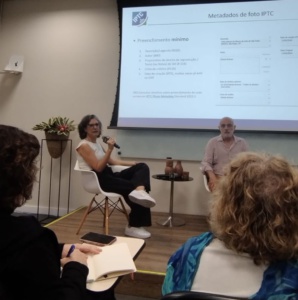
Media consultant and IPTC Individual Member Denise Durand Kremer gave a presentation on IPTC Photo Metadata at the Seminário Fototeca Brasileira – the Brazilian Photo Library Seminar.
Over three days, more than 80 people got together to discuss the idea of a national photo library for Brazil. Denise was invited by the Collection and Market group Acervo e Mercado to talk about her experience as an iconographic researcher and about the IPTC standard for photographic metadata.
Photographers, teachers, researchers, archivists and public managers from institutions such as the Museu da Imagem e do Som de São Paulo – MIS (Museum of Image and Sound of São Paulo), Funarte, Instituto Moreira Salles, Zumví and Arquivo Afro Fotográfico participated in the event.
The meeting ended with a commitment from the Executive Secretary of the Ministry of Culture, to set up a working group to take the idea forward.
The seminar was recorded and will be available on SescTV.
Update, 6 August 2024: The video has now been released publicly. You can view Denise’s section below (in Brazilian Portuguese):
Thanks very much Denise for spreading the word about IPTC standards in Brazil!
The 2024 IPTC Photo Metadata Conference takes place as a webinar on Tuesday 7th May from 1500 – 1800 UTC. Speakers hail from Adobe (makers of Photoshop), CameraBits (makers of PhotoMechanic), Numbers Protocol, Colorhythm, vAIsual and more.
First off, IPTC Photo Metadata Working Group co-leads, David Riecks and Michael Steidl, will give an overview of what has been happening in the world of photo metadata since our last Conference in November 2022, including IPTC’s work on metadata for AI labelling, “do not train” signals, provenance, diversity and accessibility.
Next, a panel session on AI and Image Authenticity: Bringing trust back to photography? discusses approaches to the problem of verifying trust and credibility for online images. The panel features C2PA lead architect Leonard Rosenthol (Adobe), Dennis Walker (Camera Bits), Neal Krawetz (FotoForensics) and Bofu Chen (Numbers Protocol).
Next, James Lockman of Adobe presents the Custom Metadata Panel, which is a plugin for Photoshop, Premiere Pro and Bridge that allows for any XMP-based metadata schema to be used – including IPTC Photo Metadata and IPTC Video Metadata Hub. James will give a demo and talk about future ideas for the tool.
Finally, a panel on AI-Powered Asset Management: Where does metadata fit in? discusses teh relevance of metadata in digital asset management systems in an age of AI. Speakers include Nancy Wolff (Cowan, DeBaets, Abrahams & Sheppard, LLP), Serguei Fomine (IQPlug), Jeff Nova (Colorhythm) and Mark Milstein (vAIsual).
The full agenda and links to register for the event are available at https://iptc.org/events/photo-metadata-conference-2024/
Registration is free and open to anyone who is interested.
See you there on Tuesday 7th May!