Categories
Archives
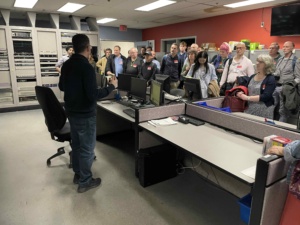
Last week, the IPTC community gathered in Toronto for our 2026 Spring Meeting, held from Monday 13th to Wednesday 15th April at the Reuters offices downtown. Three days of working group updates, guest presentations, and lively discussion were capped off by a fantastic tour of the CBC studios, newsroom, production facilities and archives.
Huge thanks to Thomson Reuters for hosting us, and to CBC / Radio-Canada for opening their doors to us on Wednesday afternoon.
A community of standards-makers
IPTC brings together people from news agencies, broadcasters, publishers, photo libraries, technology vendors, universities and standards bodies — all of whom share a common goal of making media work better through open standards and good metadata.
That community aspect shone through this week. One first-time attendee captured it perfectly: “I’ve found my people.” For those of us who have been coming to IPTC meetings for years, that sentiment is exactly why we keep showing up. There’s nowhere else quite like it for the kind of work we do.
Day 1: AI, licensing, and provenance
After a warm welcome from IPTC Managing Director Brendan Quinn and IPTC Chair Robert Schmidt-Nia, and a round of member introductions, Monday’s agenda zeroed in on some of the most pressing questions facing media organisations today.
Sannuta Raghu kicked things off with a presentation on the News Atom project, followed by Sebastian Posth on CommonsDB and Fair AI Attribution — a proposed framework for ensuring content creators are properly credited when their work is used in AI systems. Leonard Rosenthol then gave us an update on the C2PA ecosystem, setting the stage for broader discussions about provenance and trust that would run throughout the week.
Brendan Quinn presented the latest on IPTC’s AI Opt-Out Guidelines and the ongoing work at the IETF AI Preferences Working Group, which also happened to be meeting in Toronto this week. Next, Eckart Walther gave a deep dive into the possibilities of Really Simple Licensing, which is closely related to IPTC’s initiatives for expressing licensing terms in a machine-readable format.
The day closed with an extended discussion on AI opt-out, reflecting just how central these questions have become for publishers trying to navigate a rapidly-shifting landscape.
Day 2: Working group updates and new ideas
Tuesday opened with Brendan demonstrating the new IPTC member portal, followed by a packed day of working group updates:
- Video Metadata WG — Pam Fisher
- News in JSON WG — Ian Young (PA Media / Alamy)
- NewsML-G2 WG — Dave Compton (London Stock Exchange Group)
- Photo Metadata WG — David Riecks (PLUS Coalition)
- Sports Content WG / Atomic News — Paul Kelly
We also heard from Dongyan Zhao (Peking University / Xinhua News Agency) on the AI LLM discussion group, and Scott Yates of JournalList presented on Publisher Info and trust.txt — a simple but powerful approach to publisher transparency on the web.
Day 3: Provenance, watermarking, and a tour of CBC
Wednesday began with Jennifer Parrucci (New York Times) presenting on the NewsCodes WG, followed by Marcos Armstrong of CBC / Radio Canada reporting on the IPTC Media Provenance Best Practices Working Group’s project to map out a standardised blueprint for implementing C2PA in real media workflows.
Paul Harman of Bloomberg led the Standards Committee meeting where we discussed several new working group proposals, and Marc Gray of SonicOrigin gave a fascinating presentation on the state of the art in watermarking — a topic that continues to grow in importance as a counterpart to C2PA in content provenance workflows.
After lunch, Bruce MacCormack, Judy Parnall (BBC) and Charlie Halford (BBC) led the Media Provenance Committee meeting, before we decamped to CBC/Radio-Canada for an insider’s tour of the studios, newsroom, production facilities and archives. Seeing the scale of a major broadcaster’s operation, and how metadata and provenance challenges play out in practice, was a perfect way to end the meeting.
Looking ahead
Alongside the regular working group updates, members discussed proposals for new working groups and discussion groups focused on AI and LLMs in the media, Publisher Transparency, and the emerging idea of Atomic News / Liquid News. We’ll have more to share on these initiatives in the coming weeks.
Huge thanks to everyone who presented, contributed to discussions, and made the journey to Toronto. This is what IPTC does best: bringing people together to share best practices and build the standards that keep the media ecosystem running.