Categories
Archives
We had a great Photo Metadata Conference last Thursday. Thanks to those who attended. For those who didn’t, or those who would like to go over some detail again, here we publish full recordings of all sessions.
First up, Brendan Quinn, IPTC Managing Director introduced the day and gave an overview of what was to come:
Next was a great panel on adoption of the accessibility properties added in the 2021.1 update to the IPTC Photo Metadata Standard. We are very happy to share that the fields are now supported in many popular photo creating and editing tools, with more to come:
Next was David Riecks and Michael Steidl, co-leads of the IPTC Photo Metadata Working Group, presenting the work done by the Working Group since the last Photo Metadata Conference:
Then came a session on real-world implementations of the C2PA specification for content authenticity, including presentations from Microsoft, CBC / Radio Canada, the BBC and Adobe / Content Authenticity Initiative:
The last session was a panel discussion on Metadata for AI Images, looking at questions around the ethics of using copyrighted content to train a machine learning engine to generate AI images, and how the IPTC Photo Metadata Standard could be extended to support metadata appropriate for AI-generated images:
We had a great session and a packed conference! We look forward to seeing everyone again at next year’s event.
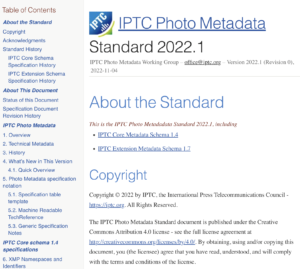 Today, the IPTC announces the release of the IPTC Photo Metadata Standard, version 2022.1.
The update has some changes to align the IPTC Photo Metadata Standard more closely which IPTC Video Metadata Hub, which helps with the integration into the C2PA specification as announced earlier this week.
The changes will be presented today (Thursday 10 November) at the IPTC Photo Metadata Conference, alongside sessions on AI and images, C2PA, and accessibility. You can still register for today’s Photo Metadata Conference, for free, at the IPTC Photo Metadata Conference 2022 event page. Video recordings from the event will be posted in the coming weeks.
The changes in detail
The IPTC Core schema has been updated to version 1.4, including the following changes:
-
Name of property Source changed to Source (Supply Chain)
-
Property Subject Code was set to legacy state
The IPTC Extension schema has been updated to version
-
New property Contributor (matching the equivalent property in IPTC Video Metadata Hub)
-
The property structure for Product has been extended with a new property Identifier
The specification document has also been updated with some edits and additions to Help Texts and User Notes.
Technical Reference update
The IPTC Photo Metadata TechReference has also been updated to include the changes in version 2022.1. This can be used by software makers to easily include the changes in the new version.
For more information on how to use the Technical Reference, please consult the IPTC Photo Metadata Technical Reference documentation.
Questions? Comments?
For any questions or comments on this update or on the IPTC Photo Metadata Standard in general, please post to the public IPTC Photo Metadata forum at iptc-photometadata@groups.io.
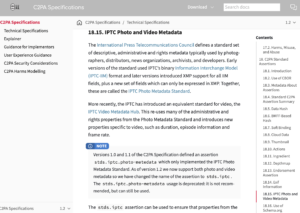
We are happy to announce that IPTC’s work with C2PA, the Coalition for Content Provenance and Authority, continues to bear fruit. The latest development is that C2PA assertions can now include properties from both the IPTC Photo Metadata Standard and our video metadata standard, IPTC Video Metadata Hub.
Version 1.2 of the C2PA Specification describes how metadata from either the photo or video standard can be added, using the XMP tag for each field in the JSON-LD markup for the assertion.
For IPTC Photo Metadata properties, the XMP tag name to be used is shown in the “XMP specs” row in the table describing each property in the Photo Metadata Standard specification. For Video Metadata Hub, the XMP tag can be found in the Video Metadata Hub properties table under the “XMP property” column.
We also show in the example assertion how the new accessibility properties can be added using the Alt Text (Accessibility) field which is available in Photo Metadata Standard and will soon be available in a new version of Video Metadata Hub.
Family Tree magazine has published a guide on using embedded metadata for photographs in genealogy – the study of family history.
Rick Crume, a genealogy consultant and the article’s author, says IPTC metadata “can be extremely useful for savvy archivists […] IPTC standards can help future-proof your metadata. That data becomes part of the digital photo, contained inside the file and preserved for future software programs.”
Crume quotes Ken Watson from All About Digital Photos saying “[IPTC] is an internationally recognized standard, so your IPTC/XMP data will be viewable by someone 50 or 100 years from now. The same cannot be said for programs that use some proprietary labelling schemes.”
Crume then adds: “To put it another way: If you use photo software that abides by the IPTC/XMP standard, your labels and descriptive tags (keywords) should be readable by other programs that also follow the standard. For a list of photo software that supports IPTC Photo Metadata, visit the IPTC’s website.“
“[IPTC] is an internationally recognized standard, so your IPTC/XMP data will be viewable by someone 50 or 100 years from now”
The article goes on to recommend particular software choices based on IPTC’s list of photo software that supports IPTC Photo Metadata. In particular, Crume recommends that users don’t switch from Picasa to Google Photos, because Google Photos does not support IPTC Photo Metadata in the same way. Instead, he recommends that users stick with Picasa for as long as possible, and then choose another photo management tool from the supported software list.
Similarly, Crume recommends that users should not move from Windows Photo Gallery to the Windows 10 Photos app, because the Photos app does not support IPTC embedded metadata.
Crume then goes on to investigate popular genealogy sites to examine their support for embedded metadata, something that we do not cover in our photo metadata support surveys.
The full article can be found on FamilyTree.com.
Anyone who has managed photo metadata can attest that it is often difficult to know which metadata properties to use for different purposes. It is especially tricky to know how to tag consistently across different metadata standards. For example, how should a copyright notice be expressed in Exif, IPTC Photo Metadata and schema.org metadata?
For software vendors wanting to build accurate mapping into their tools to make life easier for their customers, it’s no easier. For a while, a document created by a consortium of vendors known as the Metadata Working Group solved some of the problems, but the MWG Guidelines are no longer available online.
To solve this problem, the IPTC collaborated with Exif experts at CIPA, the camera products industry group that maintains the Exif standard. We also spoke with the team behind schema.org. Based on these conversations, we created a document that describes how to map properties between these formats. The aim is to remove any ambiguity regarding which IPTC Photo Metadata properties are semantically equivalent to Exif tags and schema.org properties.
Generally, Exif tags and IPTC Photo Metadata properties represent different things: Exif mainly represents the technical data around capturing an image, while IPTC focuses on describing the image and its administrative and rights metadata, and schema.org covers expressing metadata in a web page. However, quite a few properties are shared by all standards, such as who is the Creator of the image, the free-text description of what the image shows, or the date when the image was taken. Therefore it is highly recommended to have the same value in the corresponding fields of the different standards.
The IPTC Photo Metadata Mapping Guidelines outlines the 17 IPTC Photo Metadata Standard properties with corresponding fields in Exif and/or Schema.org. Further short textual notes help to implement these mappings correctly.
The intended audience of the document is those managing the use of photo metadata in businesses and the makers of software that handles photo metadata.The IPTC Photo Metadata Mapping Guidelines document can be accessed on the iptc.org website. We encourage IPTC members to provide feedback through the usual channels, and non-members to respond with feedback and questions on the public IPTC Photo Metadata email discussion group.

Bill Kasdorf, IPTC Individual Member, has written about IPTC Photo Metadata in his latest column for Publishers Weekly.
In the article, a double-page spread in the printed version of the 11/22/2021 issue of Publishers Weekly and an extended article online, Bill references Caroline Desrosiers of IPTC Startup member Scribely saying “if publications are born accessible, then their images should be born accessible, as well.”
The article describes how the new Alt Text (Accessibility) and Extended Description (Accessibility) properties in IPTC Photo Metadata can be used to make EPUBs more accessible.
Bill goes on to provide an example, supplied by Caroline Desrosiers, of how an image’s caption, alt text and extended description fulfil very different purposes, and mentions that it’s perfectly fine to leave alt text blank in some cases! For more details, read the article here.

The latest version of the International Press Telecommunications Council IPTC’s Photo Metadata Standard includes two new properties: Alt Text (Accessibility) and Extended Description (Accessibility). These will make it easier for software companies, publishers, and website developers to make websites and electronic publications more accessible.
These new properties will be introduced to the public and discussed in detail at the IPTC Photo Metadata Conference, held online next Thursday, 4th November. Registration to the IPTC Photo Metadata Conference is free and open to all.
“A major milestone in accessibility is realised through the inclusion of embedded alt text and extended descriptions as IPTC metadata for digital images,” said Beth Ziebarth, Director of Access Smithsonian. “All publicly available images can now be made accessible. As with any good inclusive practice, this benefits a range of digital image users and producers. The foresight of the IPTC Photo Metadata Working Group is commendable.”
Web accessibility is mission-critical in our digitally inclusive age. As the number of images added to the web increases every day, the visual gap widens for people using assistive technologies, especially if they are blind. Embedding image descriptions for accessibility into photo metadata promises to be a game-changer, making it possible for software and systems to routinely provide alt text with images, thus giving screen reader software the ability to help readers visualise and listen to image descriptions as they are read out loud. Without accessible descriptions, images are silent for the millions who rely on screen readers to fully access the web.
As Richard Orme, CEO of the DAISY Consortium, has pointed out, “Up to 250 million people with blindness or moderate to severe vision impairment can benefit from image descriptions, plus countless more people with diverse information processing differences such as dyslexia who use text-to-speech technology for reading.”
The year 2020 was pivotal for web accessibility. Many disabled people were at high risk of severe illness from COVID-19 but struggled to access the essentials online — everything from healthcare and education to groceries and supplies. Inaccessible websites and applications have always been a barrier; during COVID, they became a threat to the health and safety of a vulnerable population.
Image descriptions are essential for people with visual impairments using assistive technologies and a fundamental requirement of the World Wide Web Consortium’s (W3C) Web Content Accessibility Guidelines (WCAG), the most widely-used guidelines for web accessibility in the world (W3C Web Accessibility Laws and Policies).
IPTC’s new accessibility properties will make it easier for platforms and software to comply with WCAG requirements and deliver images that are inclusive for everyone. Embedding accessible image descriptions into the photo metadata will make it possible for alt text and extended descriptions to travel wherever the image goes on the web or in books or other documents provided as EPUBs.
If you are interested, there are a few things you can do now:
- Attend the IPTC Photo Metadata Conference on November 4th to understand more about the new properties and how you can use them.
- Contact your software providers to tell them about these new properties and emphasise that these features are very important to you. Ask them when they will make the new properties available in their user interface.
- Contact your web content management software provider to make that case as well.
- For larger enterprises, think about how you could implement these properties into your organisation’s workflow.
The online IPTC Photo Metadata Standard specification will be updated to the new version on 4 November 2021.
IPTC members and our guests have just finished a very busy 2021 edition of our IPTC Autumn Meeting. Held online over three days, the meeting was a mix of IPTC Working Group presentations, members presenting recent projects, and invited guest speakers on important topics in the news and media world.
This year we heard member presentations from:
- Honor Craig-Bennett of the BBC reporting on the Images Digital Asset Management system, based on the Guardian’s open-source GRID system. We heard from Andy Read about this system
- Heather Edwards from Associated Press spoke about their project to replace their existing rules-based classification system
- Mark Milstein from Microstocksolutions spoke about a new project he is working on to create “synthetic media” AI-generated images and videos based on textual descriptions and metadata
- DATAGROUP Consulting Group’s Robert Schmidt-Nia spoke about a project using AWS’s Comprehend text classification service to power a serverless news classification system using IPTC’s Media Topics vocabulary
- Frameright‘s Marina Ekroos speaking about an EU stars4media project they are working on called “Artificial Intelligence in photojournalism: can it work?”
- Scott Yates from new Startup Member JournalList spoke about the trust.txt project, letting news providers state their affiliates and official social media channels in a simple way
- Bruce MacCormack from CBC / Radio Canada spoke about Project Origin, looking at authenticity for video and news media, passing requirements to the C2PA work
- The BBC‘s Charlie Halford spoke about C2PA, updating members with a deep technical view on how the system is planned to work, as detailed in the recently-released draft specification.
In addition, we heard from guest speakers:
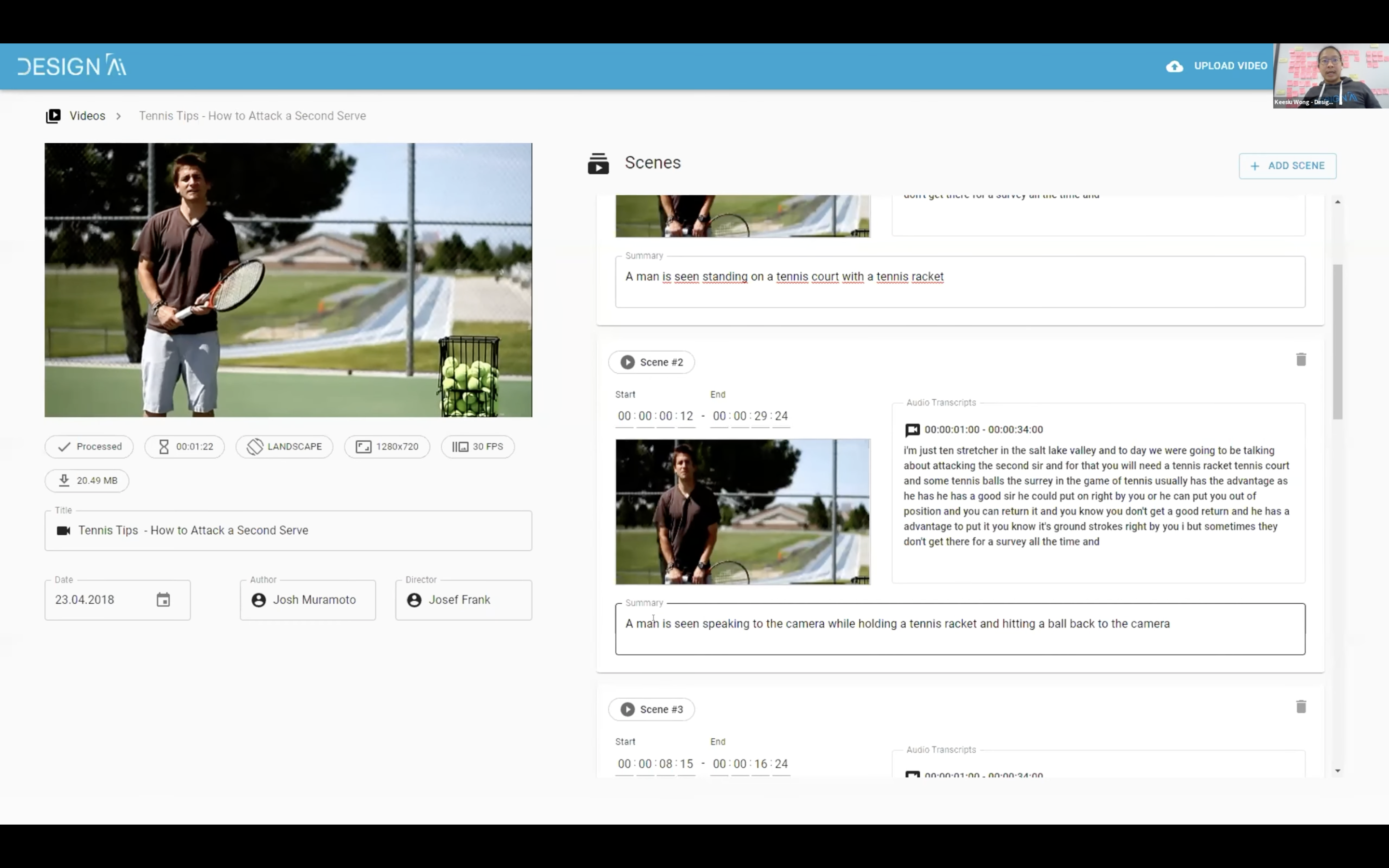
- Keesiu Wong of Design AI spoke about the Videre AI project, looking at “next-generation video understanding”. He was joined by project partner Javier Picazo from Associate Member Agencia EFE, Spain’s national news agency.
- Alex Lakatos of Interledger spoke about the distributed payments technology which is used by…
- Uchi Uchibeke of Coil who use Interledger to implement micropayments which can be implemented on publisher websites by adding one line of HTML.
New standard versions
The Working Group presentations were also packed with content, in particular three new standard versions that were proposed to the Standards Committee:
- NewsML-G2 v2.30 adds fields for “residrefformat” and “residrefformaturi” to enable publishers to describe the format of a resource ID reference, and makes catalog and catalogRef optional to support publishers who only use URIs for controlled values and therefore have no need for catalogs
- The News in JSON Working Group’s ninjs v2.0 is a non-backwards-compatible new release which changes the way repeating values are handled, moving from patternProperties fields with arbitrary names such as “body_text” and “body_html” to arrays with fixed names such as “bodies”. The objects within the array elements include properties “role” and “contenttype” which take the place of the arbitrary extension to the “body_” tag.
- The IPTC Photo Metadata Standard v2021.1 adds new properties to IPTC Core which are intended to be used for accessibility purposes: “Alt Text (Accessibility)” and “Extended Description (Accessibility)”. We have also added and Event Identifier property to align with other metadata ID properties, and modified the Description Writer field to include the writer of the accessibility fields.
New faces
We were very happy to welcome new members Frameright, JournalList, Spotlight Sports Group, Glide Publishing Platform to the meeting.
The Standards Committee was chaired for the first time by new Chair Paul Harman of Bloomberg.
The AGM was the first for new Treasurer, Gerald Innerwinkler of Austria Press Agentur APA.
And we congratulate Philippe Mougin of Agence France-Presse AFP for being voted on to the IPTC Board of Directors, along with the existing Board members who were all re-elected.
It was another great meeting with over 70 representatives from 42 organisations in 17 different countries! We’re hoping that the next IPTC member meeting will be back to face-to-face, and we have provisionally booked Tallinn, Estonia for 16 – 18 May, 2022. We will confirm this in January 2022.

The IPTC Photo Metadata Standard is widely used by photographers, photo agencies and other photo suppliers around the world. To help photo people use it properly, IPTC has a specification document with a lot of details in document form.
Now, we have released a machine-readable version of the spec that can be consumed directly by software tools.
We call it the IPTC Photo Metadata TechReference. (See below for direct links to the data files.)
The TechReference is a data object containing all the details of the IPTC Photo Metadata technical specifications in the easy-to-use JSON and YAML formats.
The file covers all IPTC properties and structures.
For each property, we specify:
- the property’s formal name
- corresponding identifiers in the ISO XMP and the IPTC IIM formats, if applicable;
- the property’s datatype, such as string, number or a custom property structure like Location; and
- the property identifier that can be used with ExifTool to read or write the metadata property (such as “XMP-dc:creator” for XMP or “IPTC:Creator” for IIM);
- … and a few more details.
We have also published rich documentation about the TechReference data object on the IPTC website. The data objects themselves can be downloaded from the IPTC site by both IPTC members and other interested parties.
Links:
Today we announce the launch of two new browser extensions for viewing IPTC Photo Metadata on web pages.
The GetPMD tool is one of IPTC’s most popular online resources. With the GetPMD tool, users can view the embedded IPTC metadata of any image on the web, whether it was embedded using either the IPTC IIM or the ISO XMP format. But up to now, users must copy and paste an image’s URL into the tool, or install a browser “bookmarklet”.
To make that a little bit easier, we have created the IPTC Photo Metadata Inspector, a simple browser extension that currently works with the Google Chrome and Mozilla Firefox browsers.
With the extension installed, a context menu will appear when you right-click on an image anywhere on the Web, with a menu option, “View IPTC Photo Metadata.” If you select that option, you will be taken to getpmd.iptc.org where you can see the embedded metadata for that image.
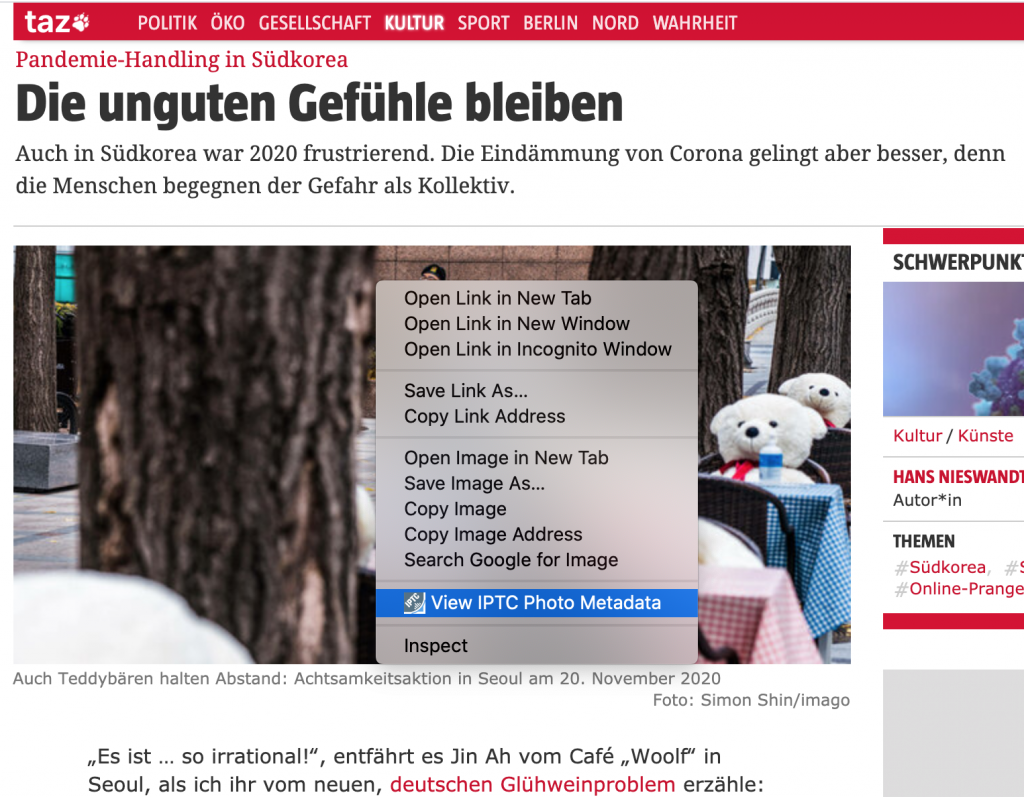
Please note that the Photo Metadata Inspector only works with simple images: it won’t work with embedded video thumbnails or tweets, for example.
The browser extensions are open source, the code is available from the IPTC’s GitHub repository.
Ideas for fixes and new features are welcome.
If you have feedback, please raise an issue on our GitHub repository, post suggestions to the iptc-photometadata@groups.io public discussion list, or contact us via the form on this site.