Categories
Archives

Last week’s 2019 IPTC Photo Metadata Conference was again hosted in association with the CEPIC Congress. This year’s conference was held in a slightly rainy Paris but at least that meant that we didn’t mind staying indoors in late May.
The event kicked off with an introduction from event chair Stéphane Guérillot from AFP, who is also on the Board of IPTC and Chair of the IPTC Standards Committee. The theme of the afternoon was “putting IPTC metadata to work for your image collections” and the emphasis on practical outcomes was a constant refrain.
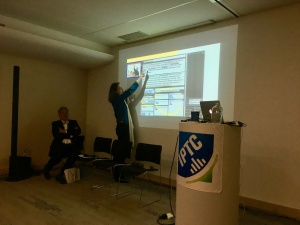
The first panel was around the question of “do we still need IPTC Photo Metadata?” Michael Steidl, lead of the IPTC Photo Metadata Working Group started off by presenting results from the IPTC Photo Metadata surveys that the Working Group has undertaken earlier this year. Lúí Smyth from Shutterstock showed how metadata has helped them to organise millions of photos from thousands of sources. Isabelle Wirth, photo editor at AFP discussed how the agency uses IPTC Photo Metadata along with other IPTC standards such as News Codes and NewsML-G2 to make content searchable and shareable for their clients. And independent photographer and 3D photogrammetry expert with Deep3D, Simon Brown, explained how metadata was crucial for creating 3D views of sunken shipwrecks via tens of thousands of still photographs and some innovative software. In Simon’s words: “For more than one 3D project, projects with multiple contributors, or projects conducted over a longer period of time, IPTC entry becomes mandatory.”
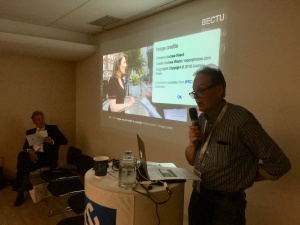
The next session examined how creating and editing IPTC Photo Metadata could be improved. Sarah Saunders representing CEPIC presented results from the IPTC Photo Metadata surveys of both image suppliers and software makers showing that metadata usage has grown in sophistication but still varies greatly between independent photographers and large companies. Andrew Wiard, photographer and member of the British Press Photographers’ Association, spoke with passion about how we could improve the handling of photo metadata once it leaves the photographer’s desk, a constant goal of the Photo Metadata Working Group and which will form part of our work plan for the rest of 2019. Mayank Sagar from Image Data Systems showed some exciting tools with videos showing how their AI algorithms can detect objects from luggage and handbags for commuters to brands and logos on advertisements in sports footage, and talked about the current limits of AI classification and future issues such as how to handle artificially synthesised images. Andreas Gnutzmann of popular photo management software Fotoware showed how their system is moving to the cloud, putting metadata at its core even more than previously.
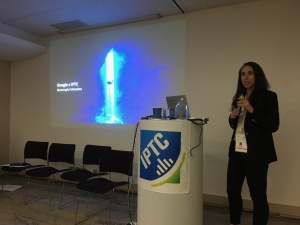
The third session looked at the end-user side and how the industry can benefit from photo metadata. Brendan Quinn of IPTC presented the Photo Metadata Crawler project, examining how news publishers around the world are embedding photo metadata in the images used on their sites. Michael Steidl showed results of the Photo Metadata Working Group’s updated analysis of social media systems and sharing platforms, which will be shared through an IPTC news article in the coming months. And Anna Dickson of Google gave us an update on her history working with images as photo editor at Huffington Post and Dow Jones among others, and discussing how Google are working with metadata and the IPTC, including our shared challenges of encouraging more site owners to publish embedded metadata so that it can be picked up by Google Search and other services. At the event, Google also announced some very interesting features that are currently in the pipeline.
Michael Steidl and Stéphane Guérillot closed out the event talking about the work the the IPTC Photo Metadata Working Group would be undertaking this year as a result of the discussions and of the survey results.
All slides from the day are available in PDF format from the event page, both to IPTC members and non-members.
Key findings from the Photo Metadata surveys will be shared in future news posts, so please watch this space for updates.
More information about the Google presentation and their proposed new features around image metadata is available to all IPTC members who have joined the Photo Metadata Working Group.
Thanks to all the speakers, to CEPIC for their assistance in hosting the conference, and to everyone who attended for making the event such a success!
This post is part of a series about the IPTC Spring Meeting 2019 in Lisbon, Portugal. See day 1 writeup and the day 3 writeup.
Tuesday was our biggest day in terms of content and also in terms of people! We had 40 people in the meeting room which was a tight squeeze, thanks to everyone for your understanding!
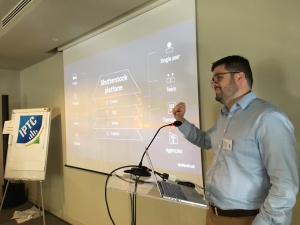
The topic focus for Day 2 was Photo and Video, so it was natural that the day was kicked off by Michael Steidl, lead of the IPTC Photo and Video Working Groups. As we had a lot of new members and new attendees in the audience, Michael gave an overview of how IPTC Photo Metadata has come to where it is today, used by almost all photography providers and even used in Google Image Search results (see our post from last year on that subject). The Photo Metadata Working Group is currently conducting a survey of Photo Metadata usage across publishers, photo suppliers (such as stock photo agencies and news wires), and software makers. Michael gave a quick preview of some of the results but we won’t spoil anything here, you will have to wait for the full results to be revealed at the 2019 IPTC Photo Metadata Conference in Paris this June. Brendan Quinn also presented a status report on the IPTC Photo Metadata Crawler which examines usage of IPTC Photo Metadata fields at news providers around the world. This will also be revealed at the Photo Metadata Conference.
Next, invited visitors Ilkka Järstä and Marina Ekroos from Frameright presented their solution to the problem of cropping images for different outlets, for example all of the different sizes required for various social media. They embed the crop regions using embedded metadata which is of great interest to the Photo Metadata Working Group, as we are looking at various options for allowing region-based metadata to cover not only an image as a whole but a region within an image, in a standardised way.
We had a workshop / discussion session on the recently ratified EU Copyright Directive which will impact all media companies in the next two years. Voted through by the European Parliament this month after intense lobbying from both sides, it could easily be bigger than GDPR, so it’s important for media outlets around the world. Discussion included how and whether IPTC standards could be used to help companies comply with the law. No doubt we will be hearing more about this in the future.
Michael then presented the Video Metadata Working Group‘s status report, including promotional activities at conferences and investigations to see what use cases we can gather from various users of video metadata amongst our members and in the wider media industry.
Then Abdul Hakim from DPP showed a practical use of video metadata in the DPP Metadata for News Exchange initiative which is based on NewsML-G2. An end-to-end demonstration of metadata being carried through from shot planning through the production process all the way to distribution via Reuters Connect. See our blog post about the Metadata for News Exchange project for more details.
Then Andy Read from BBC presented the BBC’s “Data flow for News” project, taking the principles of metadata being carried through the newsroom along with the content, looking at how to track the cost of production of each item of content and also its “audience value” across platforms to calculate a return on investment figure for all types of content. Iain Smith showed the other side of this project via a live demonstration of the BBC’s newsroom audience measurement system.
After lunch, Gan Lu and Kitty Lan from new IPTC member Yuanben presented their approach to rights protection using blockchain technology. Yuanben run a blockchain-based image registry plus a scanner that detects copyright infringements on the web. Using blockchain as proof of existence has been around for a while but it’s great to see it being used in such a practical context, very relevant for the media industry.
Lastly, another new member Shutterstock was represented by Lúí Smyth who gave us an overview of Shutterstock’s current projects relating to large-scale image management: they have over 260 million images, with over 1 million images added each week! Shutterstock are using the opportunity of refreshing their systems to re-align with IPTC standards and to learn what their suppliers, partners and distributors expect, and we look forward to helping them tackle shared challenges together.

Rights-related photo metadata can now be accessed directly in Google Image Search results, thanks to a joint effort by IPTC, Google and CEPIC, the Council of European Professional Informatics Societies.
Google, the IPTC and CEPIC worked together closely to determine the best way to incorporate metadata in Google search results of images to identify an image’s author and rights holder.
When users see an image in a Google search result, they can click the “image credits” link to see the image’s creator and credit information, read from IPTC embedded metadata. Over the coming weeks, copyright notice metadata will also be added.
“Embedded IPTC photo metadata has an essential role for photos posted on a website,” said Michael Steidl, lead of IPTC’s Photo Metadata and Video Metadata Working Groups. “These fields easily show people searching for images who its creator and copyright owner is. We encourage all parties who post images on the web to fill in these IPTC fields.”
Photo metadata is vital to guarding images’ licensing and copyright information online, and essential for managing digital assets.
The IPTC Photo Metadata Standard is the most widely used specification for describing photos, due to its universal acceptance among news outlets, photographers and photo agencies, libraries, museums and other related organisations. Most major photo software vendors support IPTC’s Photo Metadata Standard.
In a recent blog post, Google Image’s product manager Ashutosh Agarwal said this change will help promote “a healthy visual content ecosystem.”
Brendan Quinn, Managing Director of IPTC, said “we are looking forward to continuing our work with Google on IPTC Photo Metadata and other areas. We have a ton of ideas on how we can work together and are looking forward to using our standards to make the web more searchable and more accountable.”
IPTC has prepared a Quick Guide to IPTC Photo Metadata and Google Image Search to help users, developers and site administrators understand what they need to do to ensure that their metadata is shown in Google Image Search results.
For more detailed help with questions and implementation of IPTC’s Photo Metadata standard, see our IPTC Metadata User Guide.
Publishers, broadcasters, news and photo agencies and tool vendors are encouraged to join IPTC to work with us and Google on future projects. See the Participate pages for information on joining and working with IPTC.
“For years, the professional photography community has relied on IPTC metadata as the cornerstone of copyright protection,” said Andrew Fingerman, CEO of PhotoShelter, a provider of digital asset management tools for photographers and brands. “As assets are change hands, pass through organisations, and are published with greater frequency, IPTC metadata provides the basis for identifying the creator and rights owner. This major step by Google and IPTC will help everyone discover, identify, and trace copyright. We applaud this collaboration!”
For more information, contact us via this web site or email Managing Director Brendan Quinn on mdirector@iptc.org.
For more information:
IPTC Photo Metadata Standard – Guidelines and Support
Join the public IPTC Photo Metadata groups.io Group
Join IPTC: Membership Information
Twitter: @IPTC
LinkedIn: IPTC
Google Blog: Images Rights Metadata In Google Images
… the image business in a changing environment
By Sarah Saunders
The web is a Wild West environment for images, with unauthorised uses on a massive scale, and a perception by many users that copyright is no longer relevant. So what is a Smart Photo in this environment? The IPTC Photo Metadata Conference 2018 addressed the challenges for the photo industry and looked at some of the solutions.
Isabel Doran, Chair of UK image Library association BAPLA kicked off the conference with some hard facts. The use of images – our images – has created multibillion dollar industries for social media platforms and search engines, while revenues for the creative industry are diminishing in an alarming way. It has long been been said that creators are the last to benefit from use of their work; the reality now is that creators and their agents are in danger of being squeezed out altogether.
Take this real example of image use: An image library licenses an image of a home interior to a company for use on their website. The image is right-click downloaded from the company’s site, and uploaded to a social media platform. From there it is picked up by a commercial blog which licenses the image to a US real estate newsfeed – without permission. Businesses make money from online advertising, but the image library and photographer receive nothing. The image is not credited and there is no link to the site that licensed the image legitimately, or to the supplier agency, or to the photographer.
Social media platforms encourage sharing and deep linking (where an image is shown through a link back to the social media platform where the image is posted, so is not strictly copied). Many users believe they can use images found on the web for free in any way they choose. The link to the creator is lost, and infringements, where found, are hard to pursue with social media platforms.
Tracking and enforcement – a challenge
The standard procedure for tracking and enforcement involves upload of images to the site of a service provider, which maintains a ‘registry’ of identified images (often using invisible watermarks) and runs automated matches to images on the web to identify unauthorised uses. After licensed images have been identified, the image provider has to decide how to enforce their rights for unauthorised uses in what can only be called a hostile environment. How can the tracking and copyright enforcement processes be made affordable for challenged image businesses, and who is responsible for the cost?
The Copyright Hub was created by the UK Government and now creates enabling technologies to protect Copyright and encourage easier content licensing in the digital environment. Caroline Boyd from Copyright Hub demonstrated the use of the Hub copyright icon for online images. Using the icon (like this one  ) promotes copyright awareness, and the user can click on the icon for more information on image use and links back to the creator. Creating the icon involves adding a Hub Key to the image metadata. Abbie Enock, CEO of software company Capture and a board member of the Copyright Hub, showed how image management software can incorporate this process seamlessly into the workflow. The cost to the user should be minimal, depending on the software they are using.
Publishers can display the icon on images licensed for their web site, allowing users to find the creator without the involvement of – and risk to – the publisher.
Meanwhile, suppliers are working hard to create tracking and enforcement systems. We heard from Imatag, Copytrack, PIXRAY and Stockfood who produce solutions that include tracking and watermarking, legal enforcement and follow up.
Design follows devices
Images are increasingly viewed on phones and tablets as well as computers. Karl Csoknyay from Keystone-SDA spoke about responsive design and the challenges of designing interfaces for all environments. He argued that it is better to work from simple to complex, starting with design for the smartphone interface, and offering the same (simple) feature set for all environments.
Smart search engines and smart photos
Use of images in search engines was one of the big topics of the day, with Google running its own workshop as well as appearing in the IPTC afternoon workshop along with the French search engine QWANT.
Image search engines ‘scrape’ images from web sites for use in their image searches and display them in preview sizes. Sharing is encouraged, and original links are soon lost as images pass from one web site to the next.
CEPIC has been in discussion with Google for some time, and some improvements have been made, with general copyright notices more prominently placed, but there is still a way to go. The IPTC conference and Google workshop were useful, with comments from the floor stressing the damage done to photo businesses by use of images in search engines.
Attendees asked if IPTC metadata could be picked up and displayed by search engines. We at IPTC know the technology is possible; so the issue is one of will. Google appears to be taking the issue seriously. By their own admission, it is now in their interest to do so.
Google uses imagery to direct users to other non-image results, searching through images rather than for images. Users searching for ‘best Indian restaurant’ for example are more likely to be attracted to click through by sumptuous images than by dry text. Google wants to ‘drive high quality traffic to the web ecosystem’ and visual search plays an important part in that. Their aim is to operate in a ‘healthy image ecosystem’ which recognises the rights of creators. More dialogue is planned.
Search engines could drive the use of rights metadata
The fact that so few images on the web have embedded metadata (3% have copyright metadata according to a survey by Imatag) is sad but understandable. If search engines were to display the data, there is no doubt that creators and agents would press their software providers and customers to retain the data rather than stripping it, which again would encourage greater uptake. Professional photographers generally supply images with IPTC metadata; to strip or ignore copyright data of this kind is the greatest folly. Google, despite initial scepticism, has agreed to look at the possibilities offered by IPTC data, together with CEPIC and IPTC. That could represent a huge step forward for the industry.
As Isabel Doran pointed out, there is no one single solution which can stand on its own. For creators to benefit from their work, a network of affordable solutions needs to be built up; awareness of copyright needs support from governments and legal systems; social media platforms and search engines need to play their part in upholding rights.
Blueprints for the Smart Photo are out there; the Smart Photo will be easy to use and license, and will discourage freeloaders. Now’s the time to push for change.
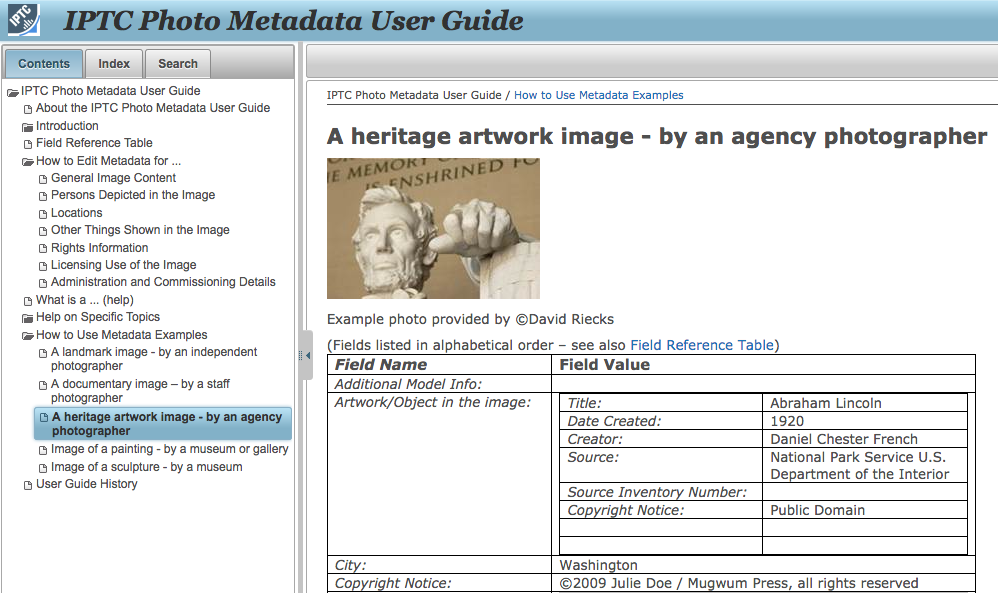
IPTC has published an updated Photo Metadata User Guide, for photographers, photo editors and professionals responsible for in-house metadata workflows, including digital asset management (DAM) systems.
Based on IPTC’s widely used Photo Metadata Standard, the new User Guide contains practical information regarding photo metadata – from photographers familiarizing themselves with basics, to managers in related businesses who have a deeper understanding of implementation of standards and metadata.
A key use of metadata is to describe the content of an image, location and rights information; the guide groups metadata fields according to information types. “The User Guide will help when deciding where metadata should be put about a certain topic, and what data should or should not be filled into a specific field,” said Michael Steidl, managing director of IPTC, and lead of IPTC’s Photo Metadata Working Group.
IPTC sets the industry standard for administrative, descriptive, and copyright information about images. The IPTC Photo Metadata Standard, supported by many software applications, is the most widely used standard because of its universal acceptance among photographers, distributors, news organisations, archivists, and developers.
The Photo Metadata User Guide walks users through the major groups of metadata, and for each IPTC field contained within each, it provides short guidelines on the use and semantics.
The first section of the guide outlines practical use for a basic understanding of applying photo metadata, and may be most helpful to photographers becoming familiar with adding it to their photos for the first time. Photo metadata is key to protecting photographers’ images, including copyright and licensing information online.
The User Guide addresses typical questions such as:
- What is a minimum set of fields to be used?
- How is metadata preserved?
Five examples of metadata for independent, staff, and agency photographers plus images of artwork are given.
Photo metadata is also essential for managing digital assets. Detailed and accurate descriptions about images ensure they can be easily and efficiently retrieved via search, by users or machine-readable code. This results in smoother workflow within organisations, more precise tracking of images, and potential for licensing opportunities.
For professionals responsible for in-house photo metadata workflows and DAM systems, all IPTC metadata fields in the User Guide have been grouped by topic for easy reference: general description, persons, locations, things shown, rights and licensing information, and administrative data.
The User Guide does not focus on the user interface of a specific software, and will be updated regularly to include more details.
For questions about the Photo Metadata User Guide or about becoming involved in IPTC’s work: Contact us.
Twitter: @IPTC
LinkedIn: IPTC
 At our three-day summer meeting in Stockholm, 13-15 June 2016, about 30 IPTC member delegates and 10 invited experts networked and discussed emerging issues and challenges affecting technology and the news industry.
Thanks to the several news agencies and vendors who gave examples of IPTC standards as the backbone of their news exchange systems and products:
Mittmedia about its use of APIs, automated creation of text news by text robots, and data-driven journalism; Profium on the use of multicast; VG on integrating newsrooms with product and technology; Infomaker on its Newspilot publishing platform; Swedish news agency TT on their Toolbox and development of digital content, strategies, and new business; Sourcefabric on its Superdesk publishing platform; Journalism++ on robots – when, where why to start; Fotoware on its digital asset management software FotoWeb. Special thanks to Johan Lindgren and TT for helping us navigate Stockholm, as well as coordinate these presentations.
We approved SportsML 3.0, a major upgrade of the premier open standard for sports data, and NewsML-G2 version 2.23 to further refine the most widely-used standard for representing news and events across all media types.
We also talked about ideas for marketing the IPTC and ways to grow our membership. We will increase our discussion of relevant news and events, as well as information about how the IPTC’s work is applied by news companies every day. We plan to produce more hands-on information about photo metadata as, judging from the traffic to our website, that’s something a lot of people are looking for.
A new and exciting way to get involved with the IPTC is EXTRA: The EXTraction Rules Apparatus. We received a grant from Google’s Digital News Initiative to build and freely distribute a multilingual open-source platform for rules-based classification of news content. If that sounds interesting, then get in touch to learn more.
Please consider joining us for our Autumn Meeting in Berlin (24 – 26 October 2016), which will feature a video workshop day, on 25 October. We plan to launch the Video Metadata Hub recommendation, a single set of video metadata properties covering the entire video workflow, including mappings and guidelines for many existing video standards.
If you have any questions about the IPTC or our Berlin meeting, please contact me at chair@iptc.org. I will be happy to discuss the benefits of becoming involved in IPTC or attending our meetings.
Regards,

Stuart Myles
Chairman, IPTC / Director of Information Management, Associated Press
Stockholm photo: Jill Laurinaitis
IPTC Releases Results of 2016 Social Media Sites Photo Metadata Test
Important image metadata is not retained in images after upload to some of the most popular social media sites, according to a study by the International Press Telecommunications Council (IPTC). The missing data includes key copyright and identification information as well as descriptive data about the image.
The IPTC, a consortium of over 50 news agencies and media companies, sets international technical standards for news exchange, including metadata embedded in image files. The recent Social Media Sites Photo Metadata Test repeats a survey in 2013; while improvements are noted, some sites scored lower this time around.
The Social Media Sites Photo Metadata Test evaluated 15 top social media sites, and checked if embedded metadata was retained and displayed on upload to the sites or downloads of various version of the image. The results are displayed at www.embeddedmetadata.org/testresults.
Only one social media site, Behance, received favorable results for retaining and displaying embedded data. A few systems retained embedded metadata but failed to use it when displaying metadata on the web site. Ten sites removed at least some metadata when images were downloaded to a desktop environment.
“There are many important reasons to embed and preserve metadata – to protect copyrights, ensure proper licensing, track image use, smooth workflow, and make them searchable on- or offline,” said Michael Steidl, Managing Director of IPTC. “If users provide captions, dates, a copyright notice and the creator within their images, that data shouldn’t be removed when sharing them on social media websites without their knowledge.”
There may be several reasons social media services remove metadata – and some may not be intentional. Test results showed that in some cases, when images were downloaded to a desktop environment, the metadata was preserved if the size of the image remained unchanged. But if the image was rescaled, the metadata was stripped. “The quality assurance of these sites might not be aware that their software strips metadata inadvertently,” said Steidl.
“Because many of the social media sites are essentially free, users become the product, and not necessarily the customers,” said David Riecks, a photographer and metadata consultant who owns ControlledVocabulary.com and worked on the test. “Users are often not aware of these practices. There should be a sweet spot between these social sites preserving all metadata and removing it all. I’d like to see more engineers working together to find solutions.”
The Embedded Metadata Manifesto was launched by IPTC in 2011 to draw attention to the importance of retaining important data embedded in image files. The website, www.embeddedmetadata.org also includes Embedded Metadata Manifesto’s five guidelines for how metadata should be handled and preserved in digital media.
About IPTC: The IPTC, based in London, brings together the world’s leading news agencies, publishers and industry vendors. It develops and promotes efficient technical standards to improve the management and exchange of information between content providers, intermediaries and consumers. The standards enable easy, cost-effective and rapid innovation and include the Photo Metadata standard, the news exchange formats NewsML-G2, SportsML-G2 and NITF, rNews for marking up online news, the rights expression language RightsML, and NewsCodes taxonomies for categorizing news. Visit www.iptc.org and follow on Twitter: @IPTC
Contact: Michael Steidl, Managing Director, mdirector@iptc.org, +44 (20) 3178 4922
David Riecks, photographer and metadata consultant, david@riecks.com, +1 (217) 689-1376
IPTC announced a new version of its Photo Metadata Standard, the most widely used standard to describe photos. It allows users to add precise and reliable data about people, products, locations and artwork shown in an image, and provides an improved and flexible way to express rights associated with a picture. IPTC is the world’s leading standards body for the news media and aims to simplify the distribution of information. The specification of this standard can be downloaded from the Photo Metadata Standard section.