Categories
Archives

The IPTC Video Metadata Working Group is proud to release the latest version of its mapping standard, Video Metadata Hub. Version 1.3 was approved by the IPTC Standards Committee on 13 May 2020.
“We are pleased to release the new version of IPTC Video Metadata Hub,” said Pam Fisher, Lead of the Video Metadata Working Group. “The changes bring improved clarity, add compatibility with and mapping to EIDR (Entertainment ID Registry), and update the mapping to EBUcore for 2020. These changes are part of our commitment to friction-free adoption across all sectors of the media landscape, supporting video interchange.”
Video Metadata Hub includes two components: a core set of recommended metadata properties to be used across all video content, and mappings that show how to implement those core properties in a series of other video standards, including Apple Quicktime, MPEG-7, Sony XDCAM MXF and SMPTE P2 from Panasonic, Canon VideoClip XML, XMP, IPTC Photo Metadata and NewsML-G2, PBCore, schema.org, In VideoMetadataHub 1.3 we now add a mapping to EIDR Data Fields 2.0.
All feedback on Video Metadata Hub should be directed to the public discussion group at https://groups.io/g/iptc-videometadata.
This post is part of a series about the IPTC Spring Meeting 2019 in Lisbon, Portugal. See day 1 writeup and the day 3 writeup.
Tuesday was our biggest day in terms of content and also in terms of people! We had 40 people in the meeting room which was a tight squeeze, thanks to everyone for your understanding!
The topic focus for Day 2 was Photo and Video, so it was natural that the day was kicked off by Michael Steidl, lead of the IPTC Photo and Video Working Groups. As we had a lot of new members and new attendees in the audience, Michael gave an overview of how IPTC Photo Metadata has come to where it is today, used by almost all photography providers and even used in Google Image Search results (see our post from last year on that subject). The Photo Metadata Working Group is currently conducting a survey of Photo Metadata usage across publishers, photo suppliers (such as stock photo agencies and news wires), and software makers. Michael gave a quick preview of some of the results but we won’t spoil anything here, you will have to wait for the full results to be revealed at the 2019 IPTC Photo Metadata Conference in Paris this June. Brendan Quinn also presented a status report on the IPTC Photo Metadata Crawler which examines usage of IPTC Photo Metadata fields at news providers around the world. This will also be revealed at the Photo Metadata Conference.
Next, invited visitors Ilkka Järstä and Marina Ekroos from Frameright presented their solution to the problem of cropping images for different outlets, for example all of the different sizes required for various social media. They embed the crop regions using embedded metadata which is of great interest to the Photo Metadata Working Group, as we are looking at various options for allowing region-based metadata to cover not only an image as a whole but a region within an image, in a standardised way.
We had a workshop / discussion session on the recently ratified EU Copyright Directive which will impact all media companies in the next two years. Voted through by the European Parliament this month after intense lobbying from both sides, it could easily be bigger than GDPR, so it’s important for media outlets around the world. Discussion included how and whether IPTC standards could be used to help companies comply with the law. No doubt we will be hearing more about this in the future.
Michael then presented the Video Metadata Working Group‘s status report, including promotional activities at conferences and investigations to see what use cases we can gather from various users of video metadata amongst our members and in the wider media industry.
Then Abdul Hakim from DPP showed a practical use of video metadata in the DPP Metadata for News Exchange initiative which is based on NewsML-G2. An end-to-end demonstration of metadata being carried through from shot planning through the production process all the way to distribution via Reuters Connect. See our blog post about the Metadata for News Exchange project for more details.
Then Andy Read from BBC presented the BBC’s “Data flow for News” project, taking the principles of metadata being carried through the newsroom along with the content, looking at how to track the cost of production of each item of content and also its “audience value” across platforms to calculate a return on investment figure for all types of content. Iain Smith showed the other side of this project via a live demonstration of the BBC’s newsroom audience measurement system.
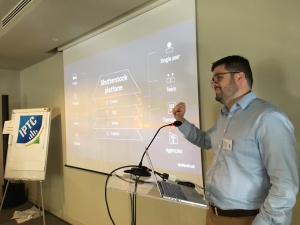
After lunch, Gan Lu and Kitty Lan from new IPTC member Yuanben presented their approach to rights protection using blockchain technology. Yuanben run a blockchain-based image registry plus a scanner that detects copyright infringements on the web. Using blockchain as proof of existence has been around for a while but it’s great to see it being used in such a practical context, very relevant for the media industry.
Lastly, another new member Shutterstock was represented by Lúí Smyth who gave us an overview of Shutterstock’s current projects relating to large-scale image management: they have over 260 million images, with over 1 million images added each week! Shutterstock are using the opportunity of refreshing their systems to re-align with IPTC standards and to learn what their suppliers, partners and distributors expect, and we look forward to helping them tackle shared challenges together.