Categories
Archives

Over 100 media provenance experts from 67 organisations around the world gathered in Toronto at the IPTC Media Provenance Summit on 16th April.
The event was co-organised by CBC/Radio-Canada and the IPTC Media Provenance Committee. It was kindly hosted for us by Reuters at their offices in Toronto, and the catering was sponsored by Getty Images.
Attendees heard from the world’s leading experts in content provenance for the media in an event that focussed on practical ways that the media industry can adopt C2PA and related content provenance technologies to protect and enhance media content in an age of AI, deepfakes and eroding trust in authentic media and journalism.
“Big tech is not going to help us – we have to help ourselves”
The event started with a keynote from Angela Pacienza, Executive Editor at Toronto’s leading newspaper The Globe and Mail, who spoke about the need for media organisations to take the lead in addressing the need for provably authentic media.
“Delivering the promise to our readers is so much harder now,” she said. “Big tech is not going to help us – we have to help ourselves.”
Following Angela’s talk were two “fireside chat” interviews conducted by Laura Ellis of the BBC: firstly Dan Dzuban, Head of Strategic Partners, Content Authenticity, Sony Corporation and current Chair of the Steering Committee of the Coalition for Content Provenance and Authenticity (C2PA), who spoke about the need for C2PA and the media industry to work together to bring provenance technology to a wider audience. Dan said that “the News industry is the spiritual core of C2PA” and was one of the most advanced industries in terms of adoption of C2PA, and that he looked forward to us working more closely together.
The next interview was with Jeremy Lockhorn, Senior Vice President, Innovative Technology at the American Association of Advertising Agencies, the industry body known as the 4As. Jeremy said that “ad agencies need to be able to share provenance of their content and people need to know who it came from. We need to empower consumers to understand the provenance of the content that they see.”
On the importance of trust, Jeremy said that “It takes decades to build a brand. One misstep and that can crumble. It’s so important to maintain trust and we see [C2PA and related technologies] as a methodology to obtain that.
“We need a single standard that we can implement once”
Jeremy went on to say that the ideal for the advertising industry is “a single industry standard that we can implement once.”
“We need a way to validate advertisers. We need a standard for what metadata to include. C2PA doesn’t specify that. CAWG doesn’t specify that.”
Next we heard from Judy Parnall and Laura Ellis who presented a case study from BBC R&D showing how AI-generated and AI-manipulated content can be signalled in a video player interface, and how fact checks can be presented to users who are interested in finding out more about how a news story was created.
6,000 testers can’t be wrong
After a short break, Marianne Fjellhaug of Media Cluster Norway presented the findings of a research paper soon to be published in a peer-reviewed journal, where the University of Bergen and University of Amsterdam found that with over 6,000 respondents across the UK, USA and Norway, in general, more provenance information displayed to users means that the users trust the publisher more. Interestingly, brands that have lower perception of trust (according to the Reuters Institute trust in news studies) gain more from users when provenance information is shown to users.
A summary of the research is available on Media Cluster Norway’s site.
Standardised workflows for C2PA in the media
Marianne was back for the next session along with Marcos Armstrong from CBC/Radio-Canada, describing their work in progress on a standardised approach to media workflows for C2PA. The work intends to create a common blueprint for the stages of production workflows across media types and media organisations, giving the industry a common framework in which to discuss where and how C2PA and related technologies can add value and drive user trust. Marcos made the point: “It’s no longer enough to report the news, it’s crucial to show how it was produced.”
CAWG: Bringing the “who” back to C2PA
Next up was Tim Murphy of Pixelstream, creator of the popular Content Credentials Foundations video series for the Content Authenticity Initiative. In a very engaging style, Time explained the Creator Assertions Working Group (CAWG) and specifically how CAWG Identity Assertions bring back the “who” aspect of C2PA that was removed in the 2.0 version of the core C2PA spec in early 2025. Using CAWG Identity Assertions, publishers can assert their organisational identity using IPTC Verified News Publisher certificates. Tim shared a great analogy: if C2PA Content Credentials is like the nutrition label on the side of a soup can, then CAWG Identity is like a brand on the front of the can.
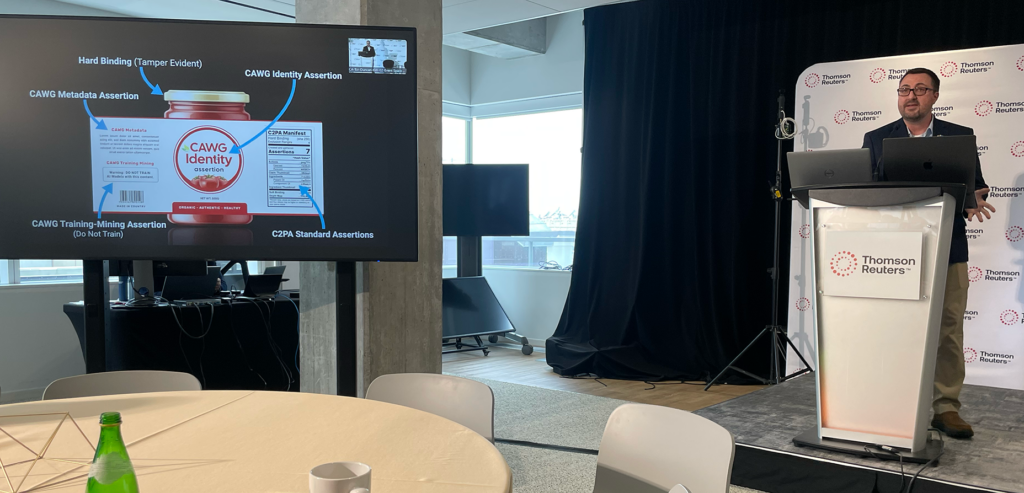
Then Brendan Quinn presented IPTC‘s work on the Origin Verified News Publisher List, which is now accepted as an official trust list by the CAWG Identity Assertion specification and the CAWG Organizational Identity Profile, which is in turn recommended as the recommended way to in the Human and Organisational Identity Recommendation in the recently-released 2.4 version of the C2PA specification. Brendan also introduced some recent changes to the IPTC’s Origin Verify C2PA Validator tool, which now shows validity against the CAI, IPTC and C2PA trust lists during this transitional time.
Bruce MacCormack, consultant with Neural Transform and Chair of the IPTC Media Provenance Committee presented his discussions with other parts of the media industry – specifically the Music, entertainment, Advertising and News industries, in a coalition that is calling itself the “MEAN group.”
“C2PA alone is insufficient,” Bruce insisted on behalf of the group. Given that C2PA no longer includes information on identity, additional specifications such as CAWG Identity Assertions must be a part of the solution and must be what is implemented by vendors across the media industry so that media organisations of all types can preserve trust in their content.
Next, Andy Parsons of Adobe, lead of the Content Authenticity Initiative, spoke about the C2PA Conformance Program and how it builds trust in the c2PA ecosystem by requiring that only conformant hardware and software implementations of C2PA, which adhere to the specifications and provide industry-standard levels of security, can obtain certificates mapping to the official C2PA Trust List.
As a follow-up, Brendan Quinn explained how he navigated the Conformance Program to achieve conformance and receive a certificate for the IPTC’s signing tool, which is used to sign the images in this post. Brendan also presented the IPTC’s plans for a “minimal generator product” which could be used by publishers to sign their content at publish time, in a C2PA- and CAWG-compliant way.
Ask the Expert
In the afternoon we held an “Ask the Expert” panel where Judy Parnall, Tim Murphy and Andy Parsons were joined by Kate Kaye from the World Privacy Forum who has been researching C2PA and related technologies such as JPEG Trust. Kate spoke about the need to preserve the privacy of users, journalists, subjects and sources and reminded us that C2PA is an evolving technology, whereby implementations that used early versions of the spec are no longer compatible with validators that use recent versions.
To bring all of these technologies and initiatives together, we looked at a case study involving a true end-to-end workflow using C2PA “from glass to glass”: from a Sony C2PA-enabled camera, through editing in Adobe Premiere and publishing with a custom C2PA-enabled publishing tool created by the European Broadcasting Union (EBU), through to display with an open-source video player. Marcos Armstrong and Sebastien Testeau from CBC were joined by Mohammed Badr Taddist from the EBU on the demo. The project went on to win the Technology Innovation Award at the NAB Show in Las Vegas a few days later.
Attendees left the event with minds full of ideas on how to implement C2PA at their media organisations, and with renewed energy to get together in IPTC Working Groups and other industry fora to solve the remaining problems.
A related event will take place in Singapore in May, and further Media Provenance Summits will take place in Bergen in September and in Tokyo in October. Stayed tuned for more news on dates and how to register.