Categories
Archives

The IPTC Photo Metadata Working Group has released version 2025.1 of the IPTC Photo Metadata Standard, including properties that can be used for AI-generated content.
The new properties are:
- AI System Used
Definition: The AI engine and/or the model name used to generate this image.
User Note: For example, ChatGPT DALL-E, Google Gemini, ChatGPT
Suggest help text: Enter the name of the AI system and/or the model name used to generate this image. - AI System Version Used
Definition: The version of the AI system used to generate this image, if known.
Suggested help text: Enter the name or number of the version of the AI system used to generate this image. - AI Prompt Information
Definition: The information that was given to the generative AI service as “prompt(s)” in order to generate this image.
User Note: This may include negative [excludes] and positive [includes] statements in the prompt.
Suggested help text: Enter the information given to the generative AI service as “prompt(s)” in order to generate this image. - AI Prompt Writer Name
Definition: Name of the person who wrote the prompt used for generating this image.
User Note: This person should not be considered as the image creator.
Suggested help text: Enter the name of the person who wrote the prompt used for generating this image.
IPTC’s specification materials have been updated to accommodate the new properties:
- IPTC Photo Metadata Standard Specification 2025.1
- The IPTC Photo Metadata User Guide has been updated, particularly the guidance on Applying Metadata to AI-generated images
- The IPTC Photo Metadata Reference Image 2025.1 which contains values for all IPTC Photo Metadata properties, including the four properties added in version 2025.1
- IPTC Photo Metadata TechReference:
- The GetPMD photo metadata reading tool has been updated to read the new fields.
The new properties are expected to be implemented in software tools soon. The popular open-source tool Exiftool already supports the new properties, since version 13.40 which was released on October 24th 2025.
Thanks to everyone who contributed to our request for comments on these new properties. We made several changes based on feedback from IPTC members and others, so your contributions were well appreciated.
For more information please contact IPTC or join our public iptc-photometadata@groups.io mailing list.
The IPTC News in JSON Working Group today released the latest in each version of the ninjs: 3.2, 2.3 and 1.7.
ninjs is IPTC’s standard for storage and distribution of news in JSON format. Using JSON means that ninjs works well for fast and simple exchange of news content for APIs, search engine platforms such as Elasticsearch and AWS OpenSearch, and for lightweight storage in databases, CMSs and cloud storage. It can be used to distribute news content in any format such as text, audio, video or images; can handle event and news coverage planning, rich metadata descriptions including relevant people, places, subjects and events; and can include packages of related news content via an associations mechanism.
The IPTC News in JSON Working Group maintains three parallel versions of ninjs so that those who implement the 1.x, 2.x or 3.x branch can all receive the latest additions in a backwards-compatible manner.
The changes adopt a new structure within the renditions array. Each rendition can now have resources associated, which allows a ninjs feed to express multiple channels or tracks within a media stream. For example, a live video stream from the EU Parliament may include several different audio tracks featuring live translations in different spoken languages; a subtitle track in WebVTT or TTML format, audio description tracks and more.
The changes have been added to all three versions of ninjs in accordance with the conventions of each version.
- https://www.iptc.org/std/ninjs/ninjs-schema_3.2.json
- https://www.iptc.org/std/ninjs/ninjs-schema_2.3.json
- https://www.iptc.org/std/ninjs/ninjs-schema_1.7.json
The ninjs User Guide, ninjs Generator tool has also been updated for the new version.
For any comments or suggestions for new properties that we should add to future versions of ninjs,
The IPTC Video Metadata Working Group is happy to announce that version 1.7 of its flagship standard, Video Metadata Hub, has now been released.
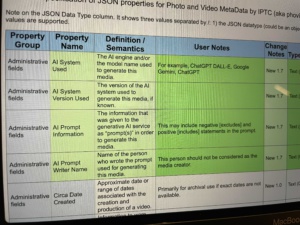
The new version has four new properties which allow users and tools to embed metadata about AI prompt information that was used to generate the image, if applicable.
The new properties in detail are:
- AI System Used (text string, single-valued, optional)
The AI engine and/or the model name used to generate this media.
Note: For example, ChatGPT DALL-E, Google Gemini, ChatGPT - AI System Version Used (text string, single-valued, optional)
The version of the AI system used to generate this media, if known. - AI Prompt Information (text string, single-valued, optional)
The information that was given to the generative AI service as “prompt(s)” in order to generate this media.
Note: This may include negative [excludes] and positive [includes] statements in the prompt. - AI Prompt Writer Name (text string, single-valued, optional)
Name of the person who wrote the prompt used for generating this media.
Note: this person should not be considered as the media creator.
Please note that users should not expect that the contents of the “AI Prompt Information” property could be given directly to an AI system to generate the same video; there are many reasons why generated media files differ even for the same input information. The Working Group decided to add “AI Prompt Information” as a generic property that creators could use to describe the process that was used to prompt an AI system to create the content.
The official IPTC Video Metadata Hub recommendation files and user documentation have all been updated for the new version:
- IPTC Video Metadata Hub 1.7 properties table
- IPTC Video Metadata Hub 1.7 full mappings table
- IPTC Video Metadata Hub 1.7 user guide
- IPTC Video Metadata Hub generator – A tool that can help developers to understand how Video Metadata Hub works and to generate example files
- IPTC Video Metadata Hub 1.7 JSON Schema
The Video Metadata Working Group welcomes feedback. Please post to the IPTC Video Metadata public discussion group or use the IPTC Contact Us form.