Categories
Archives
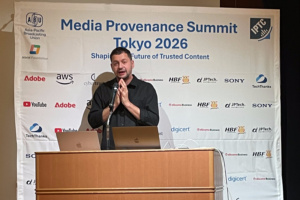
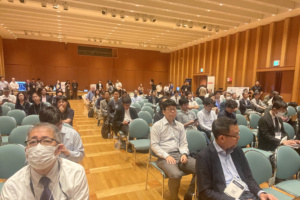
On Tuesday October 13th several hundred broadcasters, publishers, technologists and vendors filled Gate City Hall in Tokyo for the Media Provenance Summit Tokyo 2026, “Shaping the Future of Trusted Content From Asia-Pacific”. The event was hosted by the Asia-Pacific Broadcasting Union (ABU) with co-organisation support from the NHK Foundation, and the IPTC.
The programme ran from the basic principles of C2PA, with Andy Parsons of Adobe and the Content Authenticity Initiative and Dan Dzuban of Sony, deputy chair of the C2PA Steering Committee, through case studies from NHK, Fuji Television, Mediacorp and Suspilne, to an afternoon of roundtables on everything from CAWG identity to durable Content Credentials.
The message of the day was that provenance is no longer relegated to pilot projects. Broadcasters are signing real content, on real channels, today. Here are the sessions that stood out to us.
Suspilne: “Trust is the currency of public media”
The most moving session of the day came from Suspilne, Ukraine’s public broadcaster. Dmytro Khilchenko, its CTO and a member of its board, and Kyrylo Iesin, its head of product, explained why a broadcaster working through a war has made content provenance a priority, and how it now signs some of its content with its own C2PA-conformant credentials and publisher identity signature.
They began their presentation with the threat, showing a feed of AI-generated “ordinary Ukrainians” (soldiers, relatives, men of conscription age) talking about despair and avoiding service: every face fake, and more than 1m views. A single AI-generated photo of a man in a Ukrainian recruitment-office uniform, purporting to show forced recruitment of foreigners, spawned around 300 posts by the next day. Khilchenko described it as a cognitive war being fought alongside the kinetic war.
At the same time, trust is eroding and audiences are drifting away from publishers’ own sites. Some 72% of Ukrainians get their news through Telegram, and 37% rely only on social platforms. Globally, trust in news has fallen to 37%, the lowest since the Reuters Institute started measuring, and 62% of people worry they cannot tell what is real online. “Everything online is engineered to be found,” said Mr Khilchenko, referring to publishers’ efforts to make everything discoverable by search engines. “Almost nothing is engineered to be believed.”
So Suspilne changed the question from “how do we catch every fake?” to “how do we prove what is real?” In Mr Khilchenko’s words: “More than half of news consumption is now away from publisher websites. The work is not to rebuild trust. It is to let the trust we already earned travel with the journalism.” If fabrication is instant, verification has to be instant too.
What stood out to us was the modesty of the investment:
- Two cameras: C2PA-capable Sony stills cameras, provided with help from BBC Media Action.
- Three builders: two engineers and a product manager, over six months, including moving through the C2PA Conformance Program.
- Partners: engineering support from Pixelstream and the CAI community, certificates from SSL.com, with support from BBC Media Action.
- Status: conformance passed; Suspilne is on the official C2PA Trust List. Its signing key was generated inside a hardware security module and never leaves it.
The pilot is in production for selected photographs, such as the images that we saw from Suspilne reporters in Kyiv oblast after heavy shelling. Each signed image carries three things: identity (a CAWG claim that Suspilne published it), history (a C2PA record of where the file came from and every edit) and proof (a signature chained to the C2PA trust list). “Anyone can verify it,” Khilchenko said. “Nobody needs our permission.” Audio and video will come next, followed by sport, culture, education, children’s content and the archive.
Amongst the images of war and the urgency of the need for truthful content to stand out amoindst here was a lighter moment, too. Ukraine’s air-raid alert app is voiced by none other than Mark Hamill, so Ukrainians hear Luke Skywalker himself warn that “your overconfidence is your weakness” as they are encouraged to seek safety. But the point was serious: in a crisis, the voice you trust matters. And for other news organisations outside of a direct war zone, they should heed the message: overconfidence that cognitive war “won’t happen to us” really is a weakness: one that can be addressed by signing content today, before it becomes a threat to your society.
Mr Khilchenko closed with a call to the room. “Provenance only works when we do it together,” he said. “A standard only becomes infrastructure when enough of us build it. Suspilne took its seat. The next one is yours.”
Fuji Television: C2PA on live broadcast TV
The surprise of the day, for us at least, came from Fuji Television. Masashi Ito, a senior R&D engineer, and Daisuke Kawakami, a senior executive manager for broadcasting network and media strategy, revealed that Fuji TV has been using C2PA on air since June 2025.
The use case is advertising. Japan has a growing problem with fake ads on social media, many AI-generated, impersonating well-known companies and public figures; seven government ministries and agencies have jointly asked for measures against them. HTTPS cannot solve this: it authenticates the server delivering an ad, but not the advertiser who made it.
Fuji TV’s answer is to embed C2PA manifests in ad videos (both MP4 and MPEG-DASH) as they pass from advertiser to ad-review organisation. Its addressable TV advertising system, built on Hybridcast, Japan’s broadcast-broadband standard, can show a different ad in each region during a single broadcast, which can make the number of ads difficult to review manually. The ad player in the TV app extracts the provenance, verifies it and displays the result. Viewers see a Content Credentials icon on screen and can press a colour button on their remote control to see who made and approved the ad. This avoids problems that Fuji TV was seeing where ads could be “hijacked” in some regions through intercepting HTTP requests.
The numbers are striking. Since June 2025 the system has run across 120 TV programmes in real broadcasts, delivering hundreds of thousands of ad impressions per broadcast. The next demonstration is on Fuji TV’s channel on Saturday October 17th at 4pm Japan time. The work is now written into ITU-R Report BT.2267-12, whose revision was approved on October 2nd and includes a new section on Hybridcast-based personalised video services, covering addressable advertising and content provenance.
Fuji TV also showed C2PA information attached to viewer-submitted news footage; a colleague will present that case at Inter BEE in November. “Building trust takes time,” the final slide read, “one step at a time.”
ACCESS: a browser that checks provenance for you
If Fuji TV showed provenance on the broadcast side, ACCESS showed what it could look like on the viewer’s side. The Japanese embedded-software firm, founded in 1984, makes the NetFront browser that runs inside many TVs and set-top boxes, supporting standards from Hybridcast and HbbTV to ATSC 3.0.
Its prototype, NetFront Browser BE with media provenance built in, handles the whole process inside the browser engine, from retrieving provenance information through verification to rendering. It can:
- analyse and verify provenance in still images (JPEG, PNG) and in video fragments (MPEG-DASH, HLS);
- verify provenance in real time during video playback; and
- overlay a provenance icon directly on each image or video that carries Content Credentials.
The browser is still under development, but the implication is significant. Today most people can check Content Credentials only by uploading a file to a separate verification site. Building verification into the browser, and into the TV, makes provenance something viewers see without having to go looking for it.
Vendors: the tools are ready now
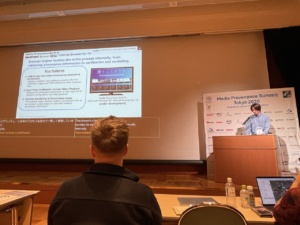
For anyone who still thinks C2PA is a research project, the sponsor lightning talks and the demo area were a useful corrective. In an hour, one vendor after another showed products for signing, identity and verification that publishers can use today:
- Sony showed its line-up of C2PA-capable cameras and newsroom workflows built with Reuters, the BBC and CBC.
- Adobe and the Content Authenticity Initiative, whose open-source tools underpin much of the ecosystem.
- DigiCert and Cybertrust, which issue the certificates that let publishers sign as themselves.
- JPTech presented LiveProof, a player that adds C2PA information to live video and verifies it in real time.
- TechThanks presented Musubi (Japanese for “binding”, the core concept of C2PA), a service designed to get publishers into production quickly with minimal custom code.
- Trufo walked through where provenance fits in a newsroom pipeline, from capture to archive, with integrations for clients such as National Geographic.
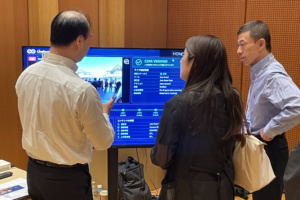
Over lunch the demo area was busy with people trying signing and verification for themselves, on laptops, phones and TV screens. The striking thing was not any single product but the breadth: cameras, certificate authorities, signing services, players and browsers. Every part of the chain now has several suppliers. As Suspilne showed, a small team can now get from zero to signed content on the official trust list in six months or less.
IPTC’s guidance and a new version of our book
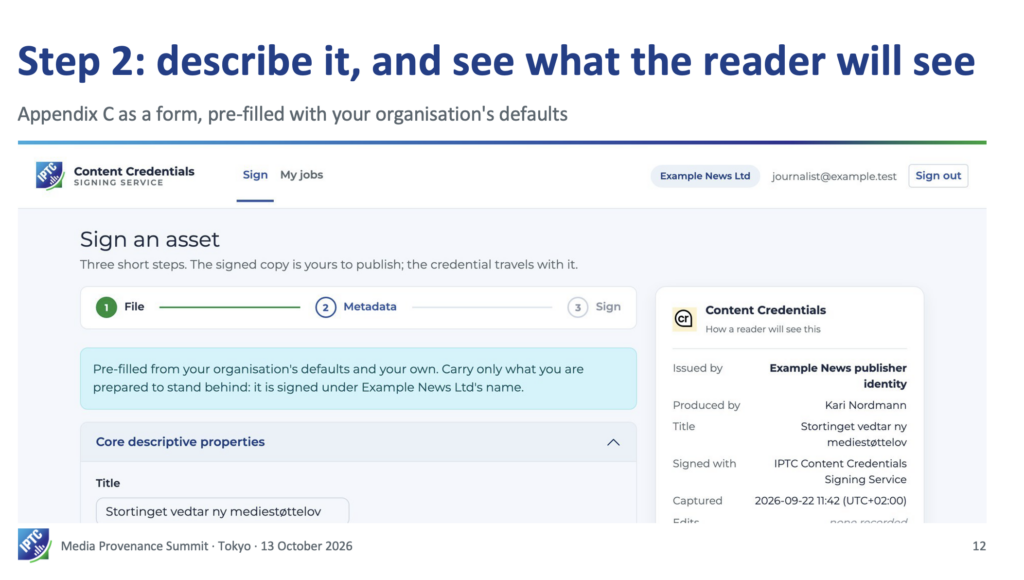
With the aim of making that adoption process even faster, Brendan Quinn of IPTC presented the IPTC Media Provenance Committee’s book, “”Media Provenance for News Publishers.” Showing how quickly things move in the content provenance world, the book has already changed slightly since the version that we handed out to attendees of the Media Provenance Summit in Bergen, Norway, only three weeks earlier. Attendees to the Tokyo event were given an 88-page printed book showing the IPTC’s recommended approach to implementing C2PA in news organisations, based on the best practices established by our members over several years: CAWG Identity signing, with publisher identity certificate added to the IPTC Verified News Publishers List, using IPTC’s specified common metadata fields, all signed by a tool on the C2PA conformance list, either created by the publisher or obtained from a commercial provider.
The book, and its associated online guidance, is available to all IPTC members and attendees of IPTC events such as this one.
What’s next
The summit made the case that provenance has moved from “whether” to “how”. A public broadcaster at war, a commercial broadcaster in Japan and a browser maker have each built something real, and the supply chain to support them is in place.
The gap now is adoption. As Suspilne put it, the value is not simply in what provenance returns today; it is that when the industry needs it, we will not be starting from scratch.
IPTC members can get involved through our Media Provenance Committee, our work on publisher identity with CAWG and the C2PA Conformance Program. If your organisation is ready to take its seat, get in touch.
Our thanks to the ABU, the NHK Foundation, the speakers and the sponsors for a superb day.