Categories
Archives
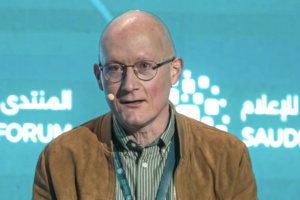
AI in the Newsroom: A High-Level Panel
Brendan Quinn, Managing Director of the IPTC, joined a high-level panel to explore the transformative impact of AI on the global media landscape. He was joined on stage by Peter Kropsch, CEO of Deutsche Presse-Agentur (dpa) and Earl J. Wilkinson, CEO of the International News Media Association (INMA). The session was moderated by Najlaa Habriri, Senior Editor and Political Commentator at Asharq Al-Awsat, a Saudi newspaper based in London.
Key Discussion Points
The wide-ranging conversation addressed how news organisations can navigate the “smart media” era:
- Content Control: Leveraging technical standards to help publishers retain rights and control over their output.
- Editorial Integrity: Integrating AI into workflows while safeguarding accuracy, accountability, and editorial responsibility.
- The Modern Newsroom: How hybrid roles, blending editorial, data, and audience expertise, are reshaping recruitment and staff development.

International representation
The forum featured many speakers from the international media industry, including Ben Smith (Semafor), Tony Gallagher (The Times), Karen Elliott House (formerly of The Wall Street Journal), Julie Pace (Associated Press) and Vincent Peyrègne (formerly of WAN-IFRA), alongside prominent local media leaders from across the Middle East.

Following on from these events, the IPTC is proud to announce that the next Media Provenance Summit will take place in Toronto Canada on April 16th 2026 at the Reuters offices.
Bringing C2PA implementation experts together from media organisations in North America and beyond, the Media Provenance Summit will look at real-world implementation of C2PA media provenance technologies in newsrooms.
Agenda
Topics will include:
- Best-practice workflows for image and video production, from capture and ingest through to publishing and distribution
- Understanding how to use organisational identity certificates and tools that conform to the C2PA Conformance Program to achieve full compliance with the C2PA specification, enabling visibility of both C2PA conformance and publisher identity in C2PA validators
- Adopting and integrating software and hardware that incorporates C2PA signing into newsroom systems and workflows
Attendees and speakers
Attendees will include senior technology, editorial and product professionals from media organisations, global news agencies, technology suppliers (both hardware and software), service providers and industry bodies. For comparison, the summit in Bergen in September 2025 had over 80 attendees from the UK, Europe, Canada, USA, Australia and Japan.
IPTC membership is not required to attend the Media Provenance Summit.
The event is being held the day after the members-only IPTC Spring Meeting 2026, which will be held at the same venue from April 13 – 15. Attendees of the IPTC Spring Meeting will include technology professionals from Associated Press, Bloomberg, New York Times, Reuters, BBC and many more leading media organisations from around the world. Many of these attendees are expected to also attend the Media Provenance Summit.
Request an invitation
To be considered for an invitation, please fill out the Expression of Interest form. Attendees will be selected to ensure a productive balance of publishers, broadcasters, tool vendors and consultants.
Selected attendees will be notified by the end of February, to give sufficient notice for planning travel arrangements.
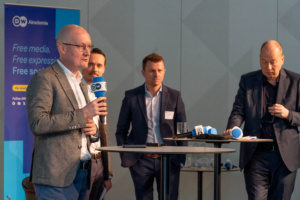
IPTC’s Managing Director Brendan Quinn spoke at the event Breaking the News? Global perspectives on the future of journalism in the age of AI in Berlin on Wednesday 28th January, an event organised by Deutsche Welle Akademie, an arm of IPTC member Deutsche Welle.
Barbara Massing, Director General, Deutsche Welle gave the opening presentation where she emphasised that all news organisations depended on earning, and keeping, the trust of their audience: “Trust is not a given. It must be earned. Every single day.”
Reem Alabali Radovan, Germany’s Federal Minister for Economic Cooperation and Development, gave her thoughts on the importance of media companies to global democracy.
Courtney Radsch of the the Open Markets Institute gave a keynote presentation where she encouraged media organisations to hold strong against the narrative pushed by AI vendors, asking them not to give in to the jargon of the industry. AI tools do not have “hallucinations”, they make “fabrications.”
IPTC’s Brendan Quinn spoke on a panel on the relationship between AI vendors and publishers, along with representatives from Open AI and Cloudflare (other AI companies were invited to attend but declined the invitation). Quinn spoke about the IPTC’s AI opt-out guidelines and discussed the complicated landscape and the lack of progress in the IETF AI Preferences Working Group, as documented in a recent Open Future Foundation paper.
A report from Deutsche Welle on the event summarised the following takeaways:
- Collaboration and solidarity: Media companies only have power together
- Tech companies need to be regulated – they won’t self-regulate
- Media need a clear understanding of tech business models
- Media can and should use public-interest AI tools
- We need a better dialogue with big tech – demonisation won’t help
- Journalism must be treated as critical infrastructure, not just an industry
Thanks to Deutsche Welle Akademie for hosting the event and inviting Brendan Quinn to speak.