Categories
Archives
 A technical paper presented at the IBC conference, entitled “A standardised framework for C2PA provenance in media workflows,” is now available to the public.
The full paper is available as a PDF via the IBC.org website.
The paper was authored by Marianne Fjellhaug of Media Cluster Norway, Marcos Armstrong of CBC/Radio-Canada and Brendan Quinn of the International Press Telecommunications Council (IPTC), with assistance from the IPTC Media Provenance Best Practices & Implementation Working Group.
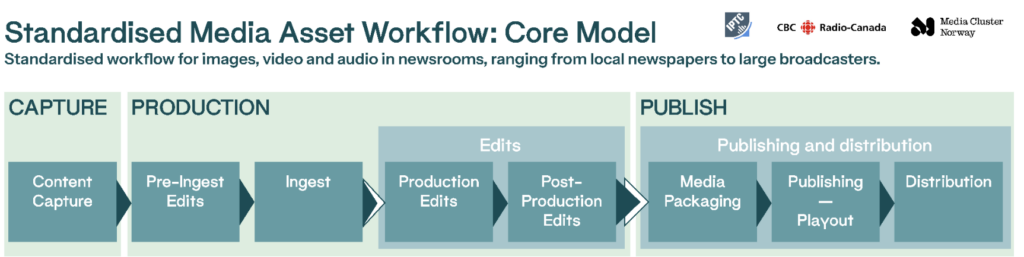
The main idea introduced by the paper is a standardised view of a typical newsroom workflow across newsrooms of varying sizes and operational contexts, moving content from capture and ingest through to packaging, publishing and distribution.
Media organisations recognise C2PA’s critical role in combating misinformation. However, implementation remains fragmented, partly due to a lack of standardised workflows and a shared vocabulary.
Developed iteratively and collaboratively by CBC/Radio-Canada, Project Reynir (Media Cluster Norway), and the IPTC Media Provenance Best Practices Working Group, the framework provides a scalable visual tool mapping media asset lifecycles from creation through distribution. It identifies critical editorial decision points, metadata loss vulnerabilities, and organisational signing recommendations.
The framework facilitates gap analysis, interoperability assessments, and establishes shared terminology across technical and non-technical stakeholders. We present a phased implementation roadmap, practical templates, and identify strengths and opportunities for further development in operationalising media provenance workflows.
The authors also discuss how content can be triaged at ingest stage using content provenance signals such as C2PA Content Credentials, to be evaluated alongside other signals such s how well a source is known and whether the metadata indicates that the content is AI-generated. This can streamline editorial workflows at the verification desk in newsrooms.
The paper includes as an appendix a “blank canvas” template that can be used to guide discussion and planning in newsrooms. It aims to provide a common framework for discussion between journalists, picture and video editors, editors and producers, legal team and technical staff, ensuring that conversations are focused in the right area and that
Comments and notes about the framework would be welcomed via the IPTC Contact Us form.